In August 2009, Yale University Press published James C. Scott's monograph "The Art of Not Being Governed: An Anarchist History of Upland Southeast Asia":
http://yalepress.yale.edu/yupbooks/book.asp?isbn=9780300152289
Publisher's description: "For two thousand years the disparate groups that now reside in Zomia (a mountainous region the size of Europe that consists of portions of seven Asian countries) have fled the projects of the organized state societies that surround them – slavery, conscription, taxes, corvée labor, epidemics, and warfare. This book, essentially an 'anarchist history,' is the first-ever examination of the huge literature on state-making whose author evaluates why people would deliberately and reactively remain stateless. Among the strategies employed by the people of Zomia to remain stateless are physical dispersion in rugged terrain; agricultural practices that enhance mobility; pliable ethnic identities; devotion to prophetic, millenarian leaders; and maintenance of a largely oral culture that allows them to reinvent their histories and genealogies as they move between and around states.
"In accessible language, James Scott, recognized worldwide as an eminent authority in Southeast Asian, peasant, and agrarian studies, tells the story of the peoples of Zomia and their unlikely odyssey in search of self-determination. He redefines our views on Asian politics, history, demographics, and even our fundamental ideas about what constitutes civilization, and challenges us with a radically different approach to history that presents events from the perspective of stateless peoples and redefines state-making as a form of 'internal colonialism.' This new perspective requires a radical reevaluation of the civilizational narratives of the lowland states. Scott's work on Zomia represents a new way to think of area studies that will be applicable to other runaway, fugitive, and marooned communities, be they Gypsies, Cossacks, tribes fleeing slave raiders, Marsh Arabs, or San-Bushmen."
Reviews: "Few scholars possess a keener capacity to recognize the agency of peoples without history and in entirely unexpected places, practices and forms. Indeed, it leads him ever closer to the anarchist ideal that it is possible for humans not only to escape the state, but the very state form itself." (Prasenjit Duara, National University of Singapore)
"A brilliant study rich with humanity and cultural insights, this book will change the way readers think about human history – and about themselves. It is one of the most fascinating and provocative works in social history and political theory I, for one, have ever read." (Robert W. Hefner, Boston University)
"Underscores key, but often overlooked, variables that tell us a great deal about why states rise and expand as well as decline and collapse. There are no books that currently cover these themes in this depth and breadth, with such conceptual clarity, originality, and imagination. Clearly argued and engaging, this is a path-breaking and paradigm-shifting book." (Michael Adas, Rutgers University)
"Finally, a true history of what pressures indigenous peoples face from these bizarre new inventions called nation states. Jim Scott has written a compassionate and complete framework that explains the ways in which states try to crowd out, envelop and regiment non-state peoples. He could take out every reference to Southeast Asia and replace it with the Arctic and it would fit the Inuit experience too. We need real applicable history that works, that fits. Truth like this, it's too darn rare." (Derek Rasmussen, former community activist in the Inuit territory of Nunavut, advisor to Nunavut Tunngavik Inc.)
"Zomia, he says, offers a sort of counter-history of the evolution of human civilization. . . . What Zomia presents, Scott argues ... is nothing less than a refutation of the traditional narrative of steady civilizational progress, in which human life has improved as societies have grown larger and more comples [sic]. Instead, for many people through history, Scott argues, civilized life has been a burden and a menace." (Drake Bennett, "Boston Globe")
"For those who live in states, savages are those who do not. Yet since the Enlightenment, there have always been Western intellectuals who want to find a critical role for the savage to play. The general idea has been to harness the otherness of indigenous or stateless people as a means of interrogating ... the modern state. In the past twenty years or so, this project has dropped off drastically .... Scott has found a creative way to revive the tradition of critical thinking about the savage – and to highlight the social goals of equality and autonomy embodied in the Zomian social order that states routinely fall short of realizing." (Joel Robbins, "Bookforum")
I decided to put up this book announcement here, rather than on the "Anti-Democracy Agenda", because some of the peoples Scott studies employ forms of autonomous/anarchist self-rule that he labels as "democratic". That label is certainly problematic in the context, since it normally is linked to statehood or a (sub)state-like polity. More importantly, though, even those peoples studied that employ more authoritarian forms of self-rule cannot necessarily be assumed to do so in conscious opposition to democracy as a form of political organization – which may never have entered their thinking.
James C. Scott is Sterling Professor of Political Science, Professor of Anthropology, and Co-Director of the Agrarian Studies Program at Yale. He is a Fellow of the American Academy of Arts and Sciences.
15 February 2010

09 February 2010
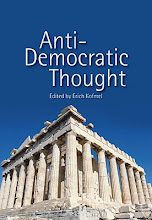
Imprint Academic book covers compared
 The new book (co-edited with András Körösényi and Gabriella Slomp) by Joseph V. Femia, Professor of Political Theory at the University of Liverpool and a former Senior Research Associate of SCIS, has just been published by Imprint Academic. The book's title is "Political Leadership in Liberal and Democratic Theory".
Released on 1 December 2009, precisely a year after my own collection "Anti-Democratic Thought" was published by Imprint Academic, it is interesting to note – and quite likely no one but me would note – that the new book cover shows the exact same picture of an ancient Greek temple that is to be seen on my own book.
One feels compelled to compare.
As good as some of the Imprint Academic cover art may be, the design of the Femia book belongs squarely into the category "awful". While the cover of my own book (to be seen in the left-hand column of this blog) is held in shiny blue, possibly promising a new day and the advent of a non-democratic future, and the temple can symbolize both democratic and anti-democratic political forms that were in existence in ancient Greece, the derivative new cover, held in black and white, plasters Abraham Lincoln and Nelson Mandela across the temple's base and pillars and somehow manages to have Winston Churchill float in the air above the building like a giant balloon.
www.booksonix.com/imprint/bookshop/title.php?9781845401726
Here anyway the publisher's description: "The working hypothesis of this book is that the issue of leadership is neglected by mainstream democratic and liberal theories. This deficiency has especially become evident in the last three or four decades, which have witnessed a revival of deontological liberalism and radical theories of participatory and 'deliberative' democracy. The contributors examine, discuss and evaluate descriptive, analytical and normative arguments regarding the role of leadership in liberal and democratic theory. The volume seeks to provoke debate and to foster new research on the significance and function of leaders in liberal democracies. The book (as a whole and in its constitutive chapters) works on two levels. First, it aims to expose the lack of systematic treatment of leadership in mainstream liberal and democratic theory. Second, it explores the reasons for this neglect. Overall, the book tries to convince the reader that liberal and democratic theories should revive the issue of leadership."
P.S. I'm currently also awaiting Alexandre J.M.E. Christoyannopoulos' monograph "Christian Anarchism: A Political Commentary on the Gospel", which was scheduled for publication by Imprint Academic on 1 January 2010, but does not seem to have been released yet. In 2008, Alex contributed a chapter, "Tolstoy's Anarchist Denunciation of State Violence and Deception", to my "Anti-Democratic Thought":
http://books.google.com/books?printsec=frontcover&id=KkMdJtaaeOYC
01 February 2010
Middle Eastern perceptions of modern American theopolitics
Found a paper that doesn't quite fit the editorial policies of my "Political Theology Agenda" blog, i.e. it hasn't been published yet. I don't include there unpublished papers from online repositories, not least because authors of such papers often don't want that anyone cites from them before they get published in a journal anyway.
However, this one is striking enough to warrant a mention at least here. It's a paper that was given at a Faith and Public Policy Seminar at King's College London on 21 April 2009, titled "America as a Jihad State: Middle Eastern perceptions of modern American theopolitics". The author is Shaikh Abdal-Hakim Murad (aka Timothy Winter; Lecturer of Islamic Studies at Cambridge). We got used to viewing the Middle East, from a western perspective, in terms of "theopolitics". This attempt at turning the tables on us may be fairly unique, though.
The full text is available here:
www.masud.co.uk/ISLAM/ahm/America-as-a-jihad-state.htm
Some excerpts: "Only two weeks ago, in the Sahara desert near Timbuktu, I listened to a wholly traditional Sufi leader expound the view that America's violence towards the Muslim world is the consequence of a sahwa misihiyya, a Christian revival. He was well-aware of the role of the Christian Coalition in the run-up to the Iraq war, despite living in a region where I saw no newspapers, and where internet access is almost impossible. Yet he was familiar with the names of Franklin Graham, Pat Robertson, and other icons of the Christian Right. [...]
"[A]n article by Jaafar Hadi Hassan in [the Lebanese-rooted newspaper] al-Hayat in 2003 [...] summarises the core passages of the [biblical] Book of Revelation which are central to the [apocalyptic]
world-view of the so-called theocons. Much of Revelation, he writes, is ambiguous, but the role of Iraq in the end-time scenario is clear: Iraq, or 'Babylon', will fill the nations with impurity; and an angel of God's wrath will bring it to destruction, and it will be divided into three parts – exactly what America has achieved. [...] The environmental crisis is a positive sign that the present world is coming to an end; and this explains, for Hassan, American indifference towards the Kyoto Protocols. [...]
"While takfiri Salafi formations such as those which self-identify as al-Qaida are content to use generic terms such as 'crusading' to account for American interventions in the Muslim world, and offer simple accounts of the power of the Jewish lobby over Christians paralyzed with guilt over the Holocaust, mainline Islamism can adopt a slightly more analytic view. [...] [W]hereas ten years ago Muslims tended to view America as a secular republic containing many religious Christians, the perception is now gaining ground that America is a specifically Christian entity, whose policies on Israel, and whose otherwise mystifying violence against Muslims, whether in occupied countries or in detention, can most helpfully be explained with reference to the Bible."
However, this one is striking enough to warrant a mention at least here. It's a paper that was given at a Faith and Public Policy Seminar at King's College London on 21 April 2009, titled "America as a Jihad State: Middle Eastern perceptions of modern American theopolitics". The author is Shaikh Abdal-Hakim Murad (aka Timothy Winter; Lecturer of Islamic Studies at Cambridge). We got used to viewing the Middle East, from a western perspective, in terms of "theopolitics". This attempt at turning the tables on us may be fairly unique, though.
The full text is available here:
www.masud.co.uk/ISLAM/ahm/America-as-a-jihad-state.htm
Some excerpts: "Only two weeks ago, in the Sahara desert near Timbuktu, I listened to a wholly traditional Sufi leader expound the view that America's violence towards the Muslim world is the consequence of a sahwa misihiyya, a Christian revival. He was well-aware of the role of the Christian Coalition in the run-up to the Iraq war, despite living in a region where I saw no newspapers, and where internet access is almost impossible. Yet he was familiar with the names of Franklin Graham, Pat Robertson, and other icons of the Christian Right. [...]
"[A]n article by Jaafar Hadi Hassan in [the Lebanese-rooted newspaper] al-Hayat in 2003 [...] summarises the core passages of the [biblical] Book of Revelation which are central to the [apocalyptic]
world-view of the so-called theocons. Much of Revelation, he writes, is ambiguous, but the role of Iraq in the end-time scenario is clear: Iraq, or 'Babylon', will fill the nations with impurity; and an angel of God's wrath will bring it to destruction, and it will be divided into three parts – exactly what America has achieved. [...] The environmental crisis is a positive sign that the present world is coming to an end; and this explains, for Hassan, American indifference towards the Kyoto Protocols. [...]
"While takfiri Salafi formations such as those which self-identify as al-Qaida are content to use generic terms such as 'crusading' to account for American interventions in the Muslim world, and offer simple accounts of the power of the Jewish lobby over Christians paralyzed with guilt over the Holocaust, mainline Islamism can adopt a slightly more analytic view. [...] [W]hereas ten years ago Muslims tended to view America as a secular republic containing many religious Christians, the perception is now gaining ground that America is a specifically Christian entity, whose policies on Israel, and whose otherwise mystifying violence against Muslims, whether in occupied countries or in detention, can most helpfully be explained with reference to the Bible."
24 January 2010
Tribal king declares secession from South Africa
This hasn't received much attention outside of SA:
On 14 January 2010, the king of the tribe Nelson Mandela belongs to served a secession notice on the South African Parliament. Only weeks after being sentenced by a South African court of law to fifteen years in jail for culpable homicide, kidnapping, arson, and assault with intent to do grievous bodily harm (all charges dating back to an event in 1995), the lawyer of King Buyelekhaya Dalindyebo declared that the abaThembu tribe would now form the independent state of Thembuland.
According to media reports, the new state – to be headed by the king who is out on bail – may comprise as much as sixty-five percent of current South Africa, in line with the pre-colonial boundaries of the tribe's land, including all of the Western, Eastern and Northern Cape provinces, KwaZulu-Natal, parts of Gauteng and the Free State, as well as the cities of Johannesburg and Durban. The king's supporters claim abaThembu to be South Africa's largest tribe with more than ten million members.
Dalindyebo – who is better known by his praise name, Zwelibanzi – is one of a handful of rightful monarchs in South Africa and a former operative of the military wing of the African National Congress (ANC), Umkhonto we Sizwe (Spear of the Nation), in Angola. Only the more surprising, then, that his legal team accuses the ANC government of a political trial aimed at replacing Dalindyebo with a puppet king.
South Africa, whose constitution attributes tribal kings a largely ceremonial role, neighbours two constitutional monarchies, Lesotho and Swaziland.
On 14 January 2010, the king of the tribe Nelson Mandela belongs to served a secession notice on the South African Parliament. Only weeks after being sentenced by a South African court of law to fifteen years in jail for culpable homicide, kidnapping, arson, and assault with intent to do grievous bodily harm (all charges dating back to an event in 1995), the lawyer of King Buyelekhaya Dalindyebo declared that the abaThembu tribe would now form the independent state of Thembuland.
According to media reports, the new state – to be headed by the king who is out on bail – may comprise as much as sixty-five percent of current South Africa, in line with the pre-colonial boundaries of the tribe's land, including all of the Western, Eastern and Northern Cape provinces, KwaZulu-Natal, parts of Gauteng and the Free State, as well as the cities of Johannesburg and Durban. The king's supporters claim abaThembu to be South Africa's largest tribe with more than ten million members.
Dalindyebo – who is better known by his praise name, Zwelibanzi – is one of a handful of rightful monarchs in South Africa and a former operative of the military wing of the African National Congress (ANC), Umkhonto we Sizwe (Spear of the Nation), in Angola. Only the more surprising, then, that his legal team accuses the ANC government of a political trial aimed at replacing Dalindyebo with a puppet king.
South Africa, whose constitution attributes tribal kings a largely ceremonial role, neighbours two constitutional monarchies, Lesotho and Swaziland.
13 January 2010
Keeping my stalker busy
I found that one good way of demonstrating to people that I am indeed getting (cyber)stalked is by leaving comments to blog posts.
Wherever I leave a comment – still under my own name, despite all the defamation –, you can be sure that the next comment (unless it gets moderated) is from my stalker, reiterating the same tired old lies.
This has been going on for two years now.
How sick must that person be?
By leaving comments, I can lead him or her around the Internet like a dog on a leash.
Read my previous posts on the cyberstalking campaign against me under this thread:
www.erichkofmel.blogspot.com/search/label/cyberstalking
Wherever I leave a comment – still under my own name, despite all the defamation –, you can be sure that the next comment (unless it gets moderated) is from my stalker, reiterating the same tired old lies.
This has been going on for two years now.
How sick must that person be?
By leaving comments, I can lead him or her around the Internet like a dog on a leash.
Read my previous posts on the cyberstalking campaign against me under this thread:
www.erichkofmel.blogspot.com/search/label/cyberstalking
06 January 2010
"Anti-Democracy Agenda" now online
Please circulate widely! Blog about it! etc.
In January 2009, I started this blog – now called "Erich Kofmel Himself" – and a blog on political theology, now called the "Political Theology Agenda".
From the outset both these blogs bore the logo of the Sussex Centre for the Individual and Society (SCIS). The renaming of the blogs at the end of last year was part of an improved online strategy of SCIS, which also includes the addition of a third blog in January 2010.
That new blog is called the "Anti-Democracy Agenda":
www.anti-democracy-agenda.blogspot.com
Description: "Conferences, Books, Articles, Trends: The Anti-Democracy Agenda is run by the Sussex Centre for the Individual and Society (SCIS) in order to serve as a focal point and the premier resource on the net for the study of anti-democratic thought and practice as well as old and new alternatives to democracy. It wishes to facilitate the exchange on anti-democratic thought and practice across boundaries, be they disciplinary, ideological, national, cultural, generational, philosophical, religious (or non-religious), etc. By disseminating information on research, publications, and events, it hopes to increase awareness of the various traditions and current trends, and raise the academic and public profile of anti-democratic thought and practice worldwide."
Already, there are almost thirty posts on the Anti-Democracy Agenda. Namely, those posts on anti-democratic thought made here during 2009 and around twenty new posts introducing in detail scholarly resources (books, articles, and so on) for the study of anti-democratic thought and practice. In future, I may continue to post personal comments on anti-democratic developments here, while posting more objective news on the Anti-Democracy Agenda. (Where I will of course also provide links to posts made here.)
The Political Theology Agenda too seems finally to get properly indexed by Google and now holds top spots for "political theology" searches on Google, Bing, and Yahoo. Throughout 2009, it accrued 75 posts, of which 31 during November and December 2009. I expect the number of posts in 2010 to be significantly higher, in line with the increasing number of people working on issues of political theology/-ies in all conceivable academic disciplines and the scholarly in- and outputs to be expected from this.
Just as I knew last year that the time had come for the Political Theology Agenda – the field had grown enough since 2006 to sustain such a blog –, the number and quality of posts on anti-democratic thought and alternatives to democracy I made here, the new publications and developments to be commented on in 2009 convinced me that the time had come for the Anti-Democracy Agenda. It will be sustained by things to come.
The term "Agenda" indicates the rationale of both blogs (and such further Agendas as SCIS may see fit to start in the future): originating from Latin, it means that "which ought to be done", a working programme – doing, acting, making. A list of matters to be worked on, to be taken up, to be contributed to. Notably, a schedule of events and readings, and a research agenda around which to coalesce.
These Agendas give visibility to novel areas of research, provide a focal point to informal networks of scholars (both at universities and independent) and people all around the world and from various backgrounds that may not know each other now and maybe never get to know one another. They provide resources, all in one place, for the benefit of those who come newly to the field or are just curious. They are an invitation to participate.
The time has come to give that kind of focus to the research agenda on anti-democratic thought and practice.
Feel free to leave a comment or contact me.
In January 2009, I started this blog – now called "Erich Kofmel Himself" – and a blog on political theology, now called the "Political Theology Agenda".
From the outset both these blogs bore the logo of the Sussex Centre for the Individual and Society (SCIS). The renaming of the blogs at the end of last year was part of an improved online strategy of SCIS, which also includes the addition of a third blog in January 2010.
That new blog is called the "Anti-Democracy Agenda":
www.anti-democracy-agenda.blogspot.com
Description: "Conferences, Books, Articles, Trends: The Anti-Democracy Agenda is run by the Sussex Centre for the Individual and Society (SCIS) in order to serve as a focal point and the premier resource on the net for the study of anti-democratic thought and practice as well as old and new alternatives to democracy. It wishes to facilitate the exchange on anti-democratic thought and practice across boundaries, be they disciplinary, ideological, national, cultural, generational, philosophical, religious (or non-religious), etc. By disseminating information on research, publications, and events, it hopes to increase awareness of the various traditions and current trends, and raise the academic and public profile of anti-democratic thought and practice worldwide."
Already, there are almost thirty posts on the Anti-Democracy Agenda. Namely, those posts on anti-democratic thought made here during 2009 and around twenty new posts introducing in detail scholarly resources (books, articles, and so on) for the study of anti-democratic thought and practice. In future, I may continue to post personal comments on anti-democratic developments here, while posting more objective news on the Anti-Democracy Agenda. (Where I will of course also provide links to posts made here.)
The Political Theology Agenda too seems finally to get properly indexed by Google and now holds top spots for "political theology" searches on Google, Bing, and Yahoo. Throughout 2009, it accrued 75 posts, of which 31 during November and December 2009. I expect the number of posts in 2010 to be significantly higher, in line with the increasing number of people working on issues of political theology/-ies in all conceivable academic disciplines and the scholarly in- and outputs to be expected from this.
Just as I knew last year that the time had come for the Political Theology Agenda – the field had grown enough since 2006 to sustain such a blog –, the number and quality of posts on anti-democratic thought and alternatives to democracy I made here, the new publications and developments to be commented on in 2009 convinced me that the time had come for the Anti-Democracy Agenda. It will be sustained by things to come.
The term "Agenda" indicates the rationale of both blogs (and such further Agendas as SCIS may see fit to start in the future): originating from Latin, it means that "which ought to be done", a working programme – doing, acting, making. A list of matters to be worked on, to be taken up, to be contributed to. Notably, a schedule of events and readings, and a research agenda around which to coalesce.
These Agendas give visibility to novel areas of research, provide a focal point to informal networks of scholars (both at universities and independent) and people all around the world and from various backgrounds that may not know each other now and maybe never get to know one another. They provide resources, all in one place, for the benefit of those who come newly to the field or are just curious. They are an invitation to participate.
The time has come to give that kind of focus to the research agenda on anti-democratic thought and practice.
Feel free to leave a comment or contact me.
Subscribe to:
Posts (Atom)


 Posts
Posts

