Showing posts with label United Kingdom. Show all posts

21 December 2009

Phillip Blond's "ResPublica" think tank and Radical Orthodoxy

One of the hundreds of people who participated in events organized by the Sussex Centre for the Individual and Society (SCIS) is Phillip Blond.

Those living in the UK may by now be familiar with that name. In 2007, when Phillip gave a presentation in the Section "Political Theology as Political Theory" that I organized and chaired at the Fourth General Conference of the European Consortium for Political Research (ECPR), he was but a lowly Senior Lecturer in theology and philosophy at what had only just become the University of Cumbria.

Phillip also participated in the Second Annual International Symposium of SCIS on "The Resurgence of Political Theology". Both events took place in September 2007 in Pisa, Italy.

Then, Phillip worried about how he was going to continue paying his mortgage on a meagre academic salary and he and his frequent collaborator and journalistic co-author, Adrian Pabst, talked about starting an online newspaper. This year, Phillip has been hailed as Tory leader (and possible prime minister come May 2010) David Cameron's "philosopher king", and been able to raise 1.5 million pounds to launch his own think tank, called (rather unimaginatively) "ResPublica":

www.respublica.org.uk

ResPublica was launched on 26 November in the presence of Cameron, but the financial backers behind it remain anonymous. It stands to reason, though, that they are in support of the ideas associated with what Phillip calls "Red Toryism". Already in Pisa, if memory serves correctly, he carried notes toward the manuscript of a book on this subject in his bag, but only in February 2009 he published an article outlining his ideas in the magazine "Prospect".

The book, "Red Tory", will not be published until April 2010 – and I should not be surprised if it won't be published at all before the UK general elections likely to take place in May 2010. (After all, Phillip's only previous monograph, "Eyes of Faith", was scheduled for publication in 2006 and has still not been released.)

Faber and Faber, who are to publish "Red Tory", have meanwhile issued a book description: "Conventional politics is at crossroads. Amid recession, depression, poverty, increasing violence and rising inequality, our current politics is exhausted and inadequate.

"In 'Red Tory', Phillip Blond argues that only a radical new political settlement can tackle the problems we face. Red Toryism combines economic egalitarianism with social conservatism, calling for an end to the monopolisation of society and the private sphere by the state and the market. Decrying the legacy of both the Labour and Conservative parties, Blond proposes a genuinely progressive Conservatism that will restore social equality and revive British culture. He calls for the strengthening of local communities and economies, ending dispossession, redistribution of the tax burden and restoration [of] the nuclear family.

"'Red Tory' offers a different vision for our future and asks us to question our long-held political assumptions. No political thinker has aroused more passionate debate in recent times. Phillip Blond's ideas have already been praised or attacked in every major British newspaper and journal. Challenging, stimulating and exhilarating, this is a book for our times."

There is a lot of hype. And that alone should give reason to be wary. As an academic, in Pisa, I found Phillip both unimpressive and unprepared. In fact, I am still waiting to receive the full text of the paper he was accepted to be giving and which I should have got prior to the conference. Phillip turned up with nothing but notes and extrapolated from those. Of the two, I always found Adrian Pabst, also a participant in Pisa (and in 2008 in a panel on "Comparative Political Theology" I organized at the Second Global International Studies Conference in Ljubljana, Slovenia), intellectually sounder and more stimulating.

Of course, David Cameron, on becoming leader of the Tories, had as little to offer in terms of his CV as Phillip has now. It all seems to be more about connections and being at the right place at the right moment with the right set of vague ideas and attitudes. Does anyone know what Cameron stands for after having been Tory leader for four years? It is hard to believe – though of course entirely in the nature of democracy – that the UK electorate would fall for a David Cameron after having rid themselves of the vacuum that was Tony Blair.

"Red Toryism" may be in 2010 what "New Labour" was in the late 1990s. Red Toryism is an ideology that came to bloom in the financial crisis, when all former boundaries between left and right, economy and state became finally blurred, and it was helped by the blurring that economy-friendly New Labour had done earlier. In fact, Red Toryism is not imaginable without New Labour preceding it.

Both Adrian Pabst (University of Nottingham) and Phillip Blond, along with Graham Ward (University of Manchester), represented the Anglican Radical Orthodoxy movement in Pisa. Radical Orthodoxy set out, hardly ten years ago, from Cambridge's Peterhouse College to renew the Church of England. Already the current Archbishop of Canterbury, and head of the Anglican community, Rowan Williams, is said to be an adherent of Radical Orthodoxy. And now the movement has gained influence over Tory policy and the likely next prime minister.

Of course, the ResPublica website does not openly refer to Radical Orthodoxy, and Phillip is not saying much about it in his interviews. The only clear reference to it is that John Milbank (University of Nottingham), "founder of the Radical Orthodoxy Movement" and Phillip's PhD supervisor (and himself a student of Williams), is listed as a Fellow of ResPublica. Radical-orthodox political theology has a chance to become for the UK what black liberation theology arguably has become under Barack Obama in the US.

One reason why the influence of Radical Orthodoxy on Red Toryism may be downplayed is the confusion of religious identity that embroils Radical Orthodoxy. While Phillip converted as an adult from Roman Catholicism to Anglicanism, one gets the impression that the Radical Orthodox consider themselves to be Catholics within the Church of England (in the "High Church" or "Anglo-Catholic" tradition). They are the very people, it would seem, the Vatican now wants to attract into its fold by offering them a separate structure within the Roman Catholic Church. Radical Orthodoxy, however, rather aims at "taking over" the Church of England. Either way, such Catholic sympathies remain suspicious in the UK, as Tony Blair demonstrated when converting to Catholicism only after having left public office.

Papers not written, books not published ... Philipp continues to work from notes. While there are many introductions to Radical Orthodoxy, all anyone knows about Red Toryism is still schematic, a fragment. It may remain so until after the UK general elections, and afterwards Phillip may be too busy to actually write the book. On the other hand, his think tank now provides him with people who may well write it for him. Very little about Tory policy is worked out and now Cameron got Phillip to work it out for him. Very little about Red Toryism is worked out and now Phillip got others to work it out for him ...

May we hope that the book (maybe helped by others) will clarify at least some of the confusion ResPublica and Phillip's writings still show? For instance, is he now against capitalism, or for capitalism – as his "mutualism" concept seems to be an extension of capitalism to the public sector (much as "New Public Management" extended New Labour's economy-friendliness to the public sector with public-private partnerships, etc.): as I understand it, public sector employees are to get shares in mutually-owned public service-providing companies, giving employees more control. But will that not mean that managers of such entities will be under less control from above and from the public?

Phillip's stepbrother is the current incarnation of James Bond, the actor Daniel Craig – already in Her Majesty's (Secret) Service. As Phillip may turn out to be soon.

Or then, his fall may be as quick as his unlikely rise.

04 November 2009

"Political theology" equals terrorism?

Point of interest: We are all terrorists.

The keyword "political theology" now triggers the following paid-for Google Ad (at least on Google's UK site):

Report terrorism
Independent charity, not the police
Report terrorism anonymously
www.Crimestoppers-uk.org

Should anyone reading this be engaged in terrorist actitivies (rather than search "political theology" on Google for religious or academic and research purposes), please denounce yourself.

Cheers,
Erich Kofmel
Editor, "Anti-Liberalism and Political Theology" (forthcoming)
www.political-theology-agenda.blogspot.com

(Update: As of 6 November, the above ad does not seem to show up on Google anymore.)

11 August 2009

Identity theft by the "Times Higher Education"

Some people still labour under the illusion that the media are objective, rather than activist, in their reporting. That is a myth that, particularly in the UK, has no bearing on reality.

I can disclose today that the weekly magazine Times Higher Education has become guilty of at least two counts of criminal identity theft in its misguided attempt to give succour to an ongoing cyberstalking campaign against me.

Over the last weekend, subscribers to the political theology mailing list (listserv) I run received two e-mails purporting to be from me, that is, they were – apparently – sent from my e-mail address ("Erich Kofmel", e.kofmel@scis-calibrate.org).

As recipients may have guessed from the content (links to articles and websites accusing me of fraudulent activities as well as outright slander and defamation), these e-mails were not sent by me. Someone stole my e-mail address (somehow "masking" their own e-mail with my sender address, much as spammers would). That is identity theft and a criminal act. The same was done earlier with my Sussex university e-mail account.

Fortunately, and for the first time, the normally hidden parts of the e-mail "header" of these two e-mails allow me to pin down the original sender. Both e-mails were sent from the same IP address: 77.73.121.5.

The server from which these e-mails were sent identifies itself as "helo=tsleducation.com" – that is the domain of the mother company of the Times Higher Education.

Much has been written recently about the journalistic practices of UK papers like the News of the World. Although the Times Higher Education – formerly the Times Higher Education Supplement – does not belong to Rupert Murdoch anymore, its journalistic practices are still as degraded as those of other UK publications (where duplicity and deception is the order of the day).

The headers of the falsified e-mails sent this weekend prove that the Times Higher Education is not only compliant in its reporting with the anonymous cyberstalker who has been pursuing me for one and a half years now (using multiple assumed and stolen identities, including my own, and repeatedly attempting to hack my e-mail accounts), but actively complicit in his or her ongoing theft of identities, that is, the magazine actively perpetrated acts of crime punishable under UK law.

Entirely unproven allegations against me have been made first on the Internet (in fora, on public mailing list, etc.). Much of this has found its way, unfiltered, into newspaper articles. There is nothing "objective" or "true" or trustworthy about them. With its criminal actions this weekend, the Times Higher Education has outed itself as entirely partisan.

There's little I can do about someone stealing my identity and e-mail address and pretending to be me. The police have so far failed to investigate in that direction. I can only urge everyone to exercise caution with regard to any e-mails you may get from the sender e.kofmel@scis-calibrate.org (or any e-mail pretending to be from me or regarding me, for that matter).

02 August 2009

Duncan Connors and the demise of the National Postgraduate Committee of the UK

Amongst the most pointless organizations I ever belonged to must certainly be counted the National Postgraduate Committee of the United Kingdom (NPC). An organization with a noble goal (the representation of postgraduate students and doctoral researchers), but without adequate funding or staffing, dwarfed by the financial prowess of the National Union of Students (which however did not represent postgraduates until just now).

Recently, one Duncan Connors (aka Duncan-Philip Connors) commented on a UK higher education messageboard about the affairs of the soon to be defunct NPC, which is apparently to be absorbed into a newly formed National Union of Students Postgraduate Committee or Conference (NUS-PC). In passing, he made some derogatory remarks about me, a former officer on the Management Sub-Committee (board) of the NPC.

Now, Duncan Connors is well known as a self-aggrandizing pompous git, if there ever was one. In fact, I don't need to insult him myself. I can just cite comments made about him on another blog two years ago: "Duncan Connors was asked to resign [as Deputy Chairman of the Conservative Party in Islington] by a unanimous vote of the executive but refused to accept that his service, or lack thereof, were no longer required. He has tried to create the illusion of a huge scandal in the association by going to the press, sending unsolicited letters and blogging his heart away when in fact, all he wants is a soapbox for his bruised ego and to pursue his own political agenda at everyone else's expense.

"From what I understand he simply wasn't up to the job – [...] All mouth and no trousers.

"the association had no choice but to force him out.

"Duncan is a bit unstable and lives quite close to me I didn't want to become the focus of his obsessive behaviour. Who knows what he is capable of. [...] He is very odd. This is especially the case when he has some moon bat juice driven delusion that he is a 'Major Player' on the political stage. Have a look at the mixture of ego mania and victim syndrome in his ramblings and you will see how likely that is."

Since Duncan's remarks about me were based not on fact, but on what others had said or written about me earlier, I am sure he will agree that a reminder of what others have said publicly about him is in order.

Is there any truth to it, though? A year after I'd left NPC of my own free will (after Duncan and I and a third officer had all run unsuccessfully for Chairman), Duncan was elected General Secretary, the only (ill-)paid position in the organization. Now there are over a hundred universities in the UK and all of them have postgraduates. Usually some forty to fifty of those would affiliate to NPC each year (that is, the local students' union or postgraduate association would pay a few hundred pounds membership fees). In Duncan's year as General Secretary only thirty universities affiliated to NPC. Even worse, the next year only thirteen renewed their affiliation. That's one tenth of UK universities.

With his dismal record in office, Duncan as General Secretary prepared the ground for the imminent take over of the NPC by the NUS. Of course, true to form, he spent the past year trying to blame this on his successor in as many public places as possible.

Duncan becoming General Secretary of NPC was always going to lead to disaster. A man who in more than one e-mail to me (that I still have) boasted that only research council-funded doctoral candidates like himself were worth his attention. How could he ever represent taught postgraduates and self-funding research students (who make up the vast majority of the postgraduate student population in the UK)?

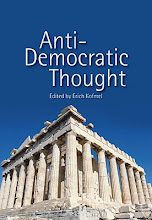
Does at least his academic record match his ego? While I published a book on "Anti-Democratic Thought" in a comparative, cross-cultural, global, and historical context, Duncan spent the last years writing an earth-shattering dissertation on (get this) "The Role of Political Decision Making in the Decline of the Shipbuilding Industries on the [river] Clyde in comparison to its international competitors, 1945-1977". Moreover, he actually got public funding to the tune of some forty or fifty thousand pounds to write such a trite that will be of no concern or interest to anyone but himself.

In his time as General Secretary, Duncan removed me from the NPC mailing list for former officers. (Although he claimed in an e-mail to me that this had not been due to him. Just another lie.) I was pleased indeed to learn that he was removed from that list by his successor in exactly the same fashion.

Ask me again why I am against democracy.

11 June 2009

Universities are the business

In a bold move designed to demonstrate just how far the marketization and commodification of higher education in the UK has gone, British prime minister Gordon Brown last week announced, as part of his cabinet reshuffle, that universities from now on would form part of the business portfolio under Peter (Lord) Mandelson.

Even more surprising and troubling, though, is the utter lack of reactions – whether positive or negative – to this rash decision. No one, it seems, can be bothered. A discussion ensued neither in the media nor on HE message boards or fora. In the current economic climate – with UK high-street chain stores closing down by the day –, few students and academics appear to mind universities being made (even more) subservient to business interests.

What is the logical consequence of all this? Increasingly, I can't help but feel that it would be more honest to "buy" a doctorate, rather than to work for it. What is the value (in a non-material sense) of a degree that comes out of such an environment?

I value my South African qualifications (both achieved with distinction in selective courses and competitive classes with up to 95% education- and knowledge-hungry black Africans) more highly than I could ever value a qualification from a sell-out UK institution.

An institution, such as the University of Sussex, talking left, but peopled mainly by the affluent middle class operating under a government that views students alternately as customers to be fleeced or (would-be) terrorists to be kept under surveillance.

Two years after leaving England, I see no reason to return.

04 June 2009

Film: The Last Enemy

Anyone willing to acquire a better understanding of the kind of society the United Kingdom is swiftly transforming itself into, can do no better than watch the five-part TV drama "The Last Enemy", produced by the BBC in 2008 and now freely available in full-length videos on YouTube:

www.youtube.com/show/thelastenemy?feature=spotlight

Different from your usual science-fiction movie, the streets of Britain in this mini series look eerily familiar and it's only the small technological changes (spread of ID cards, iris scanning, RFID chips in basically everything, access controls, database integration, and so on) that have turned it into a totalitarian society of total surveillance – or, as the film calls it, T.I.A., Total Information Awareness.

This piece is set in the very near future and the science in it is not fictitious at all. It is all here. Tomorrow, it turns out, is after all just that – tomorrow. A few hours away. Everything shown in this picture already exists, there's nothing futuristic about it. It is just a question of scale and purpose. Even the heavily armed police troops in their protective gear that seem to pop up around every corner can be found now on the streets of London and many other cities.

It is hard to get one's head around it, but only if we understand that the transition from the Weimar Republic to Nazi Germany was gradual and Germany looked by and large the same in 1930 and 1935 will we understand that the totalitarian surveillance state does not require futuristic architecture, but is at home in the picturesque and old-fashioned stone-built sceneries of the long-lost Victorian Empire as well as present-day council estates.

The synopsis of the film taken from the website of the US Public Broadcasting Service (PBS): "[After just four years abroad, mathematician] Stephen Ezard [...] returns to London to mourn the loss of his brother, Michael, and enters a society now obsessed with surveillance. Searching to make sense of Michael's death, Stephen uncovers secrets about his brother's life – including a wife he never knew Michael had. Taking a government job to trace leads through a powerful new database [T.I.A.], Stephen exposes troubling revelations and soon finds himself stalked by a rogue agent [...]. But when Stephen stumbles into an international conspiracy, he realizes that the omnipresent and menacing eye of the government has turned on him".

Total Information Awareness is being introduced in this picture with the promise: "With T.I.A., there will be nowhere to hide". No one has the right to disappear or not wanting to be found.

And, as implausible as the name may sound, T.I.A. is actually based on a US-government programme of exactly that name, introduced following 9/11, but since defunded by congress. Parts of T.I.A. continue to be pursued under the responsibility of various government agencies.

03 June 2009

SCIS Technology Ltd and the Royal Society

The Sussex Centre for the Individual and Society (SCIS) has adopted a multi- and transdisciplinary approach to the study of "the individual and society", which includes high-tech disciplines such as (but not limited to) Artificial Intelligence, Neuroscience, Genetics, Ecotechnology, and Informatics.

Three years ago, we set up SCIS Technology Ltd as a commercial venture to attract private research funding in these areas along the American model and to create income and an endowment for SCIS rather than rely on state funding. SCIS Tech offered university technology spin-outs without the bureaucratic hassle of a university – proposing to commercialize intellectual property (IP) created by doctoral candidates and young researchers that (unlink research by more senior academics) does not belong to a university.

As a pre-commercialization incubator, SCIS Tech focused on high-tech ideas and very early-stage research projects with a probable significant impact on individuals and society and expected to lead to the creation of IP and commercial ventures in the future. It set out to facilitate investment from venture capitalists, private equity firms, business angels, high net-worth individuals, corporate social responsibility programmes, and management buy-ins into ideas which at that point only existed on paper or in young innovators' minds.

We explained to potential investors that they would not be able to meet these doctoral candidates and young researchers elsewhere because they were not yet at business-plan stage and often lacked basic funding for their research. SCIS Tech would provide them with financial means at the stage at which it mattered most.

A Senior Consultant instrumental in setting up SCIS Tech was Prof John Higgins, Britain's first Professor of Biotechnology (former Leverhulme Professor, Cranfield University) and a Fellow of the Royal Society of Arts and the International Institute of Biotechnology.

In early March 2008, the Royal Society – the United Kingdom's national academy of science (and different from the Royal Society of Arts) – announced an investment programme and fundraising drive markedly similar to the one we had proposed with SCIS Technology Ltd earlier. With its superior resources, the Royal Society easily overtook our efforts.

As ResearchResearch.com, under the headline "Royal Society turns to venture capitalism", reported at the time: "The Royal Society says it's going into business, for the first time in its 350-year history. The society has announced that it will create an enterprise fund to support innovation and very early stage research with potential for commercial applications. However, rather than giving money in the form of grants, the Royal Society's financial input will take the form of a commercial investment. The society plans to raise £20 million for the fund, and has already taken £3 million in contributions from several venture capitalists".

As usual, misrepresentation on part of the journalist may be involved here, but note the emphasis on "very early-stage research" that distinguishes the approaches of SCIS Tech and the Royal Society from other such projects. Business incubators and venture capitalists alike normally expect to see clear evidence of research results as well as technological feasibility studies, and ideally patents and other IP, before committing to support any idea financially.

It seems that the focus of the Royal Society may have changed since the initial announcement in a more traditional direction, too (possibly due to the addition of some people with a traditional venture capital background to the fund's governing structures). However, funders of the "Royal Society Enterprise Fund" will, differently from SCIS Tech, now not receive any return on their "investments" – which are to be considered philanthropic gifts.

Rather, it is the fund that will play the part of venture capitalist and invest (donated) monies into promising ideas, primarily in the Physical Sciences and Engineering. Down the line, any profits resulting from such ventures are to replenish the fund and become available for new investments. Unlike most scientific funding opportunities, no mention is made as to what level of their academic careers potential beneficiaries should be at.

Intriguingly, no news has been published on the fund since September 2008 (before the global financial crisis), when its capital had reached £5 million, and their website is still skeletal. Stephen Cox, Executive Secretary of the Royal Society, writes in the spring 2009 issue of Inside Science, the Royal Society's magazine, though: "The Royal Society Enterprise Fund is now officially open for business and we are looking for support, both to calibrate the quality of the opportunities presented to us and for information about potential new technology companies which need financial backing":

www.royalsociety.org/downloaddoc.asp?id=6163

I invite Mr Cox to look no further than www.scis-calibrate.org for assistance in calibrating any proposals. Certainly, the Royal Society has at its disposal means and networks we did not have. But I feel vindicated that SCIS Tech wasn't a bad idea after all, just very ambitious.

SCIS has since decided to focus its core capacities on the social- and political-theoretical aspects of new technologies and on the assessment of their likely impact on the individual and society in the twenty-first century.

29 May 2009

On the crisis of parliamentarianism in the United Kingdom

Much is being written these days on the crisis of parliamentarianism in the UK, caused by the exposure of practices apparently shared by parliamentarians across all political parties and factions of claiming unjustified allowances and expenses that had either not arisen to them (for example, for a non-existent second home in their constituency or in London) or that were not linked to their political mandate (porn films, garden manure, dog food, etc.). Some resignations from the parliamentary benches and government have already been tendered and more are expected to follow.

There is growing concern that the unfolding of events may lead to anti-democratic sentiment and action amongst the populace (such as gains for the neo-fascist British National Party in the upcoming elections to the European Parliament) and it would indeed be easy for an avowed anti-democrat to take this as an occasion to slap and slander parliamentary democracy, just as the mainstream media, led on by the newspaper Daily Telegraph, "glory" in doing.

The usual mode of anti-democratic thought and criticism of democracy would have been to take the news from Britain as a proof of the inherent weakness of every democratic system of governance. Let's be real, though, and agree that this just as easily could have happened in any corrupt authoritarian country. The real lesson to be learned here is that democracies are no better than authoritarian governments. They can claim no moral advantage or high ground – or they will do so at their own peril.

As I wrote in my paper "Fighting Capitalism and Democracy", the notion that democracy is intrinsically linked to money, and democratic power is linked to material wealth, is as old as democracy itself. In the very first democracies, in ancient Greece, as James Bryce stated,
'[t]he power of money and the greed for money appears from the prevalence of bribery and the frequent embezzlement of the public funds' (Modern Democracies: I/206). The same has held true for every democracy since.

The new mode of anti-democratic thought that I am propagating takes the recent events not as sufficient reason to doubt democracy. It rather takes them as one more reason to doubt capitalism and the fixation on money that characterizes our present time and order – and to doubt democracy because of its inherent linkage to capitalism.

Just a few years back similar "scandals" erupted in Germany and at the European Union as well as in South Africa ("Travelgate"). In all these countries, parliamentarianism survived – as it will undoubtedly, for the time being, in the UK.

The difference between now and then, other countries and the UK is however significant. What British members of parliament now experience and endure is a sort of personal and professional destruction – that will be satisfied only with complete annihilation of the man or woman targeted. Other people, less in the public spotlight, have been enduring such treatment at the hands of the UK media for a long time. Myself, I have been subjected to it by an anonymous cyberstalker and compliant media for over a year now.

It's the naming and shaming that the media laws in most other countries prohibit – people, parliamentarians and others, being called criminals and frauds by journalists and not given the chance to set the record straight and defend themselves against allegations that are either false, unproven, or rest on the worst possible interpretation of shaky evidence and questionable facts. There is no presumption of innocence here and the sentence is not to be spoken by a court of law or a body of parliamentary control, but by public opinion. The sentence is the destruction of people's reputations and existence at the hands of unaccountable forces, with no right to appeal.

That is the way the media work in the UK. As the Guardian newspaper reports: "The MP for Mid-Bedfordshire, Nadine Dorries, claimed the Telegraph's expenses campaign was proving so invasive that some MPs were on suicide watch. 'The atmosphere in Westminster is unbearable,' she wrote on her blog. 'People are constantly checking to see if others are OK. Everyone fears a suicide. If someone isn't seen, offices are called and checked.'"

In another country with similar penchant for personal destruction, South Korea, former president Roh Moo-hyun was driven to suicide only last week by corruption charges he strongly denied. Again in the Guardian, a citizen of South Korea comments: "I've never been so ashamed of being a citizen of this country, a country that kills its own president [...]. It feels like we've lost all respect in pushing each other to extremes."

The partner of a UK member of parliament, in the same newspaper, meant likewise: "The British public – not all of them, but the smug guardians of morality who are enjoying this crisis so much – say they are disgusted by the behaviour of our elected representatives. Let me say that it works both ways: for the first time in my life, I am sick of my country. I am sick of the daily undermining of democracy, and sick of the sadistic pleasure people take in humiliating decent public servants. Even so, I will go on urging my friend not to give up her seat. She is a brilliant constituency MP, and I don't believe anyone should give in to bullies."

As if to prove the fact that the victims of such mob rule and media man hunt deserve no right to defend themselves, or point to the media's agenda and consequences of their actions, lawyers acting for the Daily Telegraph swiftly got a court order against Nadine Dorries that forced her to shut down her blog:

www.guardian.co.uk/politics/2009/may/23/dorries-tory-mp-blog-taken-down

This is not about democracy or anti-democracy, or about whether someone may have bent the rules. It's not about being in favour of or against parliaments. Make no mistake, I am against them. The issue here is personal. It's a personalized smear and defamation campaign against particular parliamentarians, although numerous, not against parliament as an institution. That is why most people in the UK do not perceive what is happening as an attack on democracy. The campaign is not anti-democracy, it's anti-those-representing-democracy.

It is not aimed at democracy as an abstract principle, but at humans who are being thrown to the wolves, merciless, by corporate interests and base instincts. This campaign is the biggest thing since 9/11, with new revelations day after day after day. Self-righteously, it claims to be about the misuse of public funds. In sober truth, though, it is about selling newspapers. It is almost certain that the Daily Telegraph paid money – that is, employed corruption of public officials itself – to obtain the information they now use against MPs. Money, here as always, shapes public opinion. And no one believe for a moment that one could not uncover similar stories about each and every Daily Telegraph executive and manager – they are just not likely ever to be published.

Nothing of the scale of the public reaction in the UK has happened or could even be imagined to happen in similar cases elsewhere in Europe. The British "stiff upper lip" is an imperial upper-class myth that always hid the fact that Britain is a nation of binge-drinking chavs and the venomous media serving them. In its majority, it is a vile people full of spite and bile that enjoys wallowing in the gutter. It is a sign of the times that even the conservative and formerly serious Daily Telegraph has stooped so low.

While indeed such a "scandal" could happen under authoritarian rule too, the moralistic and moralizing nonsense, the media's double standards now so publicly exhibited in the UK, and the vilification of members of parliament lies entirely in the nature of the beast, in the nature of democracy. Already in ancient Greece, politicians who had fallen from public favour were subjected to a vote in the citizens' assembly that would decide whether they should be killed or merely sent into exile.

The sentence was as harsh as any passed by a tyrant, but a collective decision meant that no one had to feel responsible individually when fellow men were stripped of their rights as citizens.

It's the politics of anonymous total personal annihilation and character assassination.

Short, suicide or murder by proxy.

20 May 2009

A ranking of electronic police states

The worldwide-operating Chicago-based Internet security and privacy protection company Cryptohippie USA, Inc. has released a ranking of what they call "electronic police states":

https://secure.cryptohippie.com/pubs/EPS-2008.pdf

As I suggested earlier, their research confirms that the United Kingdom ranks by now as the most highly developed police state in Europe, leading even the United States in this regard. Both the UK and US, at positions 5 and 6, respectively, rank only marginally better than such communist or formerly communist abodes of unfreedom as China and North Korea, Belarus and Russia (1 and 2, 3 and 4).

Further cause for concern should be the fact that other core countries of the European Union, namely France and Germany, also rank in the top ten. It stands to reason that the EU as a whole will swiftly catch up with the big three member states.

As the authors of the study explain, "[t]he usual image of a 'police state' includes secret police dragging people out of their homes at night, with scenes out of Nazi Germany or Stalin's USSR. The problem with these images is that they are horribly outdated. That's how things worked during your grandfather's war – that is not how things work now.

"The electronic police state is quiet, even unseen. All of its legal actions are supported by abundant evidence. It looks pristine. [...]
[E]very surveillance camera recording, every email you send, every Internet site you surf, every post you make, every check you write, every credit card swipe, every cell phone ping ... are all criminal evidence, and they are held in searchable databases, for a long, long time. Whoever holds this evidence can make you look very, very bad whenever they care enough to do so. You can be prosecuted whenever they feel like it – the evidence is already in their database.

"Do you [...] trust [...] every government worker and every policeman? And, if some leader behaves badly, will you really stand up to oppose him or her? Would you still do it if he had all the emails you sent when you were depressed? Or if she has records of every porn site you've ever surfed? Or if he knows every phone call you've ever made? Or if she knows everyone you've ever sent money to? Such a person would have all of this and more – in the form of court-ready evidence – sitting in a database, waiting to be organized at the touch of a button.

"This system hasn't yet reached its full shape, but all of the basics are in place and it is not far from complete [...]. It is too late to prevent this – it is here. Our purpose in producing this report is to let people know that their liberty is in jeopardy and to help them understand how it is being undermined."

Factors taken into account for this comparative ranking include, among others, requirements for national identity documents (i.e. biometric passports), inspections at borders and searches of computers, mandatory decryption of data and prohibition or restriction of data encryption, financial tracking, ISP and phone data retention, data storage and search ability by state authorities (i.e. police and intelligence agencies), as well as "covert hacking" ("State operatives removing – or adding! – digital evidence to/from private computers covertly. Covert hacking can make anyone appear as any kind of criminal desired").

19 March 2009

On getting arrested in the UK

As is well known, since the 1990s the United Kingdom has become the country most densely populated by CCTV cameras. In all major cities, everyone is being watched almost every moment of their lives – when they are in public, and often even while they are in private.

Still, many people do not perceive just how rapidly the UK is turned into a surveillance and police state (defined as a state in which the police – and other intelligence agencies – are largely uncontrolled and left to do as they please). To everyone with a sense of history, the situation must be reminiscent of the build-up to totalitarian rule under Nazism in 1930s Germany.

Laudably, the “Guardian” newspaper continues to expose the worst excesses of British policing. Here a selection of articles published in the last few months.

On the powers of British police to arrest anyone for any reason whatsoever:

www.guardian.co.uk/commentisfree/henryporter/2009/mar/06/civil-liberties-police

According to this article, “[a] retired senior police officer has expressed concern about the 'sweeping power' that he claims is being abused on a daily basis in all of the 43 police forces” of the country. He, a former police man himself, even started a petition “against police powers to arrest any person for any offence” – including “not wearing a seatbelt, dropping litter, shouting in the presence of a police officer, climbing a tree, and building a snowman”:

petitions.number10.gov.uk/PowersofArrest/

As he explains, under section 110 of the Serious Organised Crime and Police Act 2005 no arrest has to be justified by police anymore.

A similar statement has been made by Dame Stella Rimington, former head of intelligence agency MI5:

www.guardian.co.uk/uk/2009/feb/17/government-exploiting-terrorism-fear

It is not me but Rimington who calls Britain a “police state”.

On the driving force behind such sweeping powers of arrest, the Association of Chief Police Officers – a private company that is not subject to any public scrutiny, but nevertheless runs its own secret intelligence unit –, see this article:

www.guardian.co.uk/commentisfree/henryporter/2009/feb/10/police-civil-liberties

The website of the ACPO:

www.acpo.police.uk/about.html

“Why was ACPO so keen to make every offence arrestable? Look no further than the DNA database. The more people the police arrest, the more profiles they could add to the database. [Already] the profiles of more than 7% of the population, including one million children[!], are on the DNA database”:

www.guardian.co.uk/politics/2009/feb/27/dna-database-children-criminal-record

Half of those on the UK's DNA database have no criminal record. As everyone arrested is entered into the database, one can conclude that half of those arrested are never convicted of a crime. People falsely arrested and then not prosecuted or found innocent will not be removed from the database.

In his petition, the former senior police officer writes: “young and inexperienced police officers, (and soon, PCSO's [police community support officers]), are being trained that arrest and detention of a suspect is the first option in most encounters with the public. This sweeping power is being roundly abused ... and puts you, your wife, husband or partner, your children and your friends at risk of arbitrary action by the police”.

The situation is even more dire for foreigners (such as students, doctoral candidates and postdocs, but also occasional visitors) in the UK: Reportedly from April 2009, the new UK “e-Borders” scheme will be collecting the biometrics – including fingerprints, DNA, iris patterns, and face recognition – as well as travel information and credit card details of everyone entering or leaving the UK, by air, sea, or rail. Information on an estimated 250 million journeys a year into and out of the UK will be stored in one central database for up to 10 years. Moreover, foreign residents in the UK already require an identity card that contains biometric data. This scheme is to be expanded to British nationals and European residents by 2012. The “national identity register” will be yet another database containing information on millions of people:

www.guardian.co.uk/uk/2009/feb/25/data-surveillance-identity

This obsession with surveillance and data collection is bound to lead to consequences such as those experienced by some UK residents of Muslim origin, described by a court as “of good character and well-respected in their communities” that have been prohibited, under UK anti-terrorism legislation, from spending any of their own money – with no way left to them to challenge the measures imposed on them. Such persons are rendered “criminally liable for activities as mundane as spending the change in their pockets” and will be punished with up to seven years' imprisonment if they do. One of the men reports asking his solicitor whether his “son was allowed to buy me milk from the shop ... The answer was no”. No one in their households is allowed to work because any household income “would count as the transfer of funds which could be used for my benefit”:

www.guardian.co.uk/politics/2008/nov/03/terrorism-welfare-spending-law

If you are a foreigner it may happen to you that you get arrested on an occasional visit to the UK on the basis of some wild accusations, totally unproven, simply so police can question you, search you, fingerprint you, and take your DNA sample for entry into a plethora of databases – all of which they cannot do without an arrest, for which, however, they need no justification whatsoever. There has to be no intention of charging you with a serious offence or crime and no evidence against you. Police may then release the foreigner, who is neither a UK citizen nor resident in the UK, on police bail and expect him to return after so many months (of investigations that start only after the arrest!) to the UK at his own expense. If he decides not to follow up on such highly questionable arrest, he may become wanted in the UK. However, it is then up to UK police to request such a person's extradition from another country. In which case UK police will have to make their case in a foreign court – where they can't exercise the sweeping and uncontrolled powers granted to them in the UK.