Please circulate widely!
CALL FOR PAPERS
Anti-Democracy Agenda Symposium 2011
Organized by: Sussex Centre for the Individual and Society (SCIS)
Mode: Online by Google+ video conference
Date: 15-16 November 2011
The "Anti-Democracy Agenda" is the premier resource on the net for the study of anti-democratic thought and practice across the boundaries of various traditions and academic disciplines. First introduced by the Sussex Centre for the Individual and Society (SCIS) as a blog in January 2010, it has since been reconstituted as a circle (with associated public posts, much like a blog) on the new social network Google+. An archive of the blog is to be found here: http://anti-democracy-agenda.blogspot.com
For the new circle, see here:
https://plus.google.com/109507108125539761871/posts
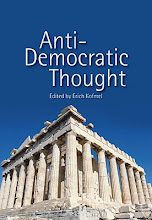
The Anti-Democracy Agenda Symposium 2011 will be the third event we organize to advance the research agenda on anti-democratic thought and practice as well as old and new criticisms of democracy. It will build up on a highly successful workshop on anti-democratic thought SCIS organized at the Annual Conference Workshops in Political Theory in Manchester, England, in September 2007, as well as the Anti-Democracy Agenda Symposium 2010, taking place at the Swiss Federal Institute of Technology (ETH) Zurich in November last year. Both events drew participants from the world over. The Manchester workshop led to the publication of an edited volume on "Anti-Democratic Thought" (Imprint Academic, 2008).
The Anti-Democracy Agenda Symposium 2011 is set to be equally international and interdisciplinary in scope. We invite affiliated academics, independent scholars, and doctoral students and candidates from a wide range of disciplines, such as Philosophy, Political Theory, Political Science, International Relations, Development Studies, Security Studies, Law, Economics, Sociology, Anthropology, Psychology, Literature, History, Classics, Theology, Religious Studies, Education, and so on. Papers may not only cover any and all aspects of criticisms of democracy and anti-democratic thought and practice, from perspectives including anarchism, libertarianism, conservatism, communism, Islamism, the extreme right, and others, but also related concepts such as authoritarianism, dictatorship, military rule, monarchy, chieftaincy, mixed constitution, the backlash against democracy promotion, terrorism, post-democracy, voter apathy, voter ignorance, etc. Have a look at the blog to see what might be of interest and falls within our remit. Papers may be theoretical and/or empirical in nature. Work in progress is welcome too.
This symposium may be the first academic conference to make use of the “Hangouts” video conference facility that is an integral part of Google+. Due to technical restrictions, the number of participants in the Anti-Democracy Agenda Symposium 2011 is limited to 10. All accepted participants will be required to create a profile on Google+ in order to be able to participate in the event. While we encourage the participation of scholars from developing countries, please only apply if you have access to a stable Internet connection. As in our previous physical events, over the course of two days, each presenter will have 60 minutes to present his or her paper and discuss it with all others. Due to the small size of the symposium, all participants are expected to attend both days fully.
As with all SCIS events, no fees will be charged from participants, and no funding is available to cover participants' expenses (if any). We will be glad to issue letters of acceptance on request to assist participants in securing leave from work. Detailed instructions on how to set up a Google+ profile and join the video conference will be provided to confirmed participants.
Please send your proposal to: erichkofmel@gmail.com
Deadline: 15 October 2011
Later submissions may still be accepted, but early submission is strongly advised and proposals may be accepted as they come in.
Cordially,
Erich Kofmel
Managing Director / Research Professor of Political Theory
Sussex Centre for the Individual and Society (SCIS)
https://plus.google.com/109507108125539761871
E-mail: erichkofmel@gmail.com
Postal address:
Sussex Centre for the Individual and Society
1200 Geneva
Switzerland
SCIS is an international association under Swiss law.
Founded 2006 at the University of Sussex.
Showing posts with label call for papers. Show all posts
Showing posts with label call for papers. Show all posts
16 August 2011

14 November 2010
CFP: "The Solitary Being" – Symposium in the Botanical Garden
Please circulate widely!
CALL FOR PAPERS
Fifth Anniversary International Symposium "The Solitary Being"
Organized by: Sussex Centre for the Individual and Society (SCIS)
Location: Orangery of the Botanical Garden of the University of Bern, Switzerland
Date: 26-27 May 2011
The "solitary man" is a staple of popular culture as much as philosophy. From medieval religious hermits to people medically diagnosed with autism or antisocial personality disorder, from the lone wolf of American frontier romanticism to the loner running amok in a university, from Ibn Bajjah/Avempace's "The Governance of the Solitary" to Nietzsche's "Übermensch", from the reclusive artist to Japan's tens of thousands of "hikikomori" voluntarily choosing to withdraw from society, examples are not limited to the arguably individualistic modern West, but rather seem to range across all societies, cultures, and times. There always have been those who do not fit the stereotype of man as a social being. Nevertheless, people who keep to themselves and do not engage in collaborative social action tend to be overlooked by social and political researchers and are therefore understudied.
The solitary human being (male or female) has been one of the interests of the Sussex Centre for the Individual and Society (SCIS) since its foundation in 2006. To celebrate our fifth anniversary in 2011, we will be organizing a rare symposium on "The Solitary Being" in the unique settings of a Botanical Garden. Previous SCIS symposia drew participants from the world over. Our anniversary symposium is set to be equally international and interdisciplinary in scope. We invite affiliated academics, independent scholars, and doctoral students and candidates from a wide range of disciplines, such as Anthropology, Sociology, Philosophy, Political Theory, Political Science, Cultural Studies, Literature, Theology, Religious Studies, Psychology, Cognitive Science, Law, History, Education, and so on. Papers may cover any and all aspects of "the solitary being" and/or his or her interaction with the (social) world. Papers may be theoretical and/or empirical in nature. Work in progress is welcome too.
We expect that 15-20 participants will be attending this workshop-style symposium. Over the course of two full days, each presenter will have 45-60 minutes (depending on the number of participants) to present his or her paper and discuss it with all others. The symposium starts early on Thursday and ends Friday late in the afternoon. Due to the small size of the symposium, all participants are expected to attend both days (unless an exception has been agreed in advance, i.e. for religious observance on Friday).
As with all SCIS events, no fees will be charged from participants, and no funding is available to cover participants' travel and accommodation expenses. We will be glad to issue letters of acceptance on request to assist participants in securing funding from their usual sources. The city of Bern – Switzerland's capital –, is connected to both the Zurich and Geneva international airports by direct train (approx. one hour from Zurich, two hours from Geneva) and offers a choice of accommodation. The historic town centre is a UNESCO World Heritage Site. The Botanical Garden of the University of Bern is arranged in descending terraces on the slopes of the river Aar, a tributary of the Rhine. On more than two hectares, it showcases vegetation from various ecological zones, in greenhouses and outdoors, such as alpine plants from Europe, Asia, and North America, tropical and subtropical plants (including orchids, palms, ferns, and cacti), Mediterranean, cold steppe, and semi-desert plants, woodland, water, medical, and fibre plants. Around six thousand plant species will make our anniversary symposium a feast of the senses, forms, fragrances, and colours. Further information will be provided to confirmed participants.
Please send your proposal to: e.kofmel@sussexcentre.org
Extended deadline: 30 April 2011
Later submissions may still be accepted, but early submission is strongly advised and proposals may be accepted as they come in.
Cordially,
Erich Kofmel
Managing Director / Research Professor of Political Theory
Sussex Centre for the Individual and Society (SCIS)
www.sussexcentre.org
E-mail: e.kofmel@sussexcentre.org
Postal address:
Sussex Centre for the Individual and Society
1200 Geneva
Switzerland
SCIS is an international association under Swiss law.
Founded 2006 at the University of Sussex.
CALL FOR PAPERS
Fifth Anniversary International Symposium "The Solitary Being"
Organized by: Sussex Centre for the Individual and Society (SCIS)
Location: Orangery of the Botanical Garden of the University of Bern, Switzerland
Date: 26-27 May 2011
The "solitary man" is a staple of popular culture as much as philosophy. From medieval religious hermits to people medically diagnosed with autism or antisocial personality disorder, from the lone wolf of American frontier romanticism to the loner running amok in a university, from Ibn Bajjah/Avempace's "The Governance of the Solitary" to Nietzsche's "Übermensch", from the reclusive artist to Japan's tens of thousands of "hikikomori" voluntarily choosing to withdraw from society, examples are not limited to the arguably individualistic modern West, but rather seem to range across all societies, cultures, and times. There always have been those who do not fit the stereotype of man as a social being. Nevertheless, people who keep to themselves and do not engage in collaborative social action tend to be overlooked by social and political researchers and are therefore understudied.
The solitary human being (male or female) has been one of the interests of the Sussex Centre for the Individual and Society (SCIS) since its foundation in 2006. To celebrate our fifth anniversary in 2011, we will be organizing a rare symposium on "The Solitary Being" in the unique settings of a Botanical Garden. Previous SCIS symposia drew participants from the world over. Our anniversary symposium is set to be equally international and interdisciplinary in scope. We invite affiliated academics, independent scholars, and doctoral students and candidates from a wide range of disciplines, such as Anthropology, Sociology, Philosophy, Political Theory, Political Science, Cultural Studies, Literature, Theology, Religious Studies, Psychology, Cognitive Science, Law, History, Education, and so on. Papers may cover any and all aspects of "the solitary being" and/or his or her interaction with the (social) world. Papers may be theoretical and/or empirical in nature. Work in progress is welcome too.
We expect that 15-20 participants will be attending this workshop-style symposium. Over the course of two full days, each presenter will have 45-60 minutes (depending on the number of participants) to present his or her paper and discuss it with all others. The symposium starts early on Thursday and ends Friday late in the afternoon. Due to the small size of the symposium, all participants are expected to attend both days (unless an exception has been agreed in advance, i.e. for religious observance on Friday).
As with all SCIS events, no fees will be charged from participants, and no funding is available to cover participants' travel and accommodation expenses. We will be glad to issue letters of acceptance on request to assist participants in securing funding from their usual sources. The city of Bern – Switzerland's capital –, is connected to both the Zurich and Geneva international airports by direct train (approx. one hour from Zurich, two hours from Geneva) and offers a choice of accommodation. The historic town centre is a UNESCO World Heritage Site. The Botanical Garden of the University of Bern is arranged in descending terraces on the slopes of the river Aar, a tributary of the Rhine. On more than two hectares, it showcases vegetation from various ecological zones, in greenhouses and outdoors, such as alpine plants from Europe, Asia, and North America, tropical and subtropical plants (including orchids, palms, ferns, and cacti), Mediterranean, cold steppe, and semi-desert plants, woodland, water, medical, and fibre plants. Around six thousand plant species will make our anniversary symposium a feast of the senses, forms, fragrances, and colours. Further information will be provided to confirmed participants.
Please send your proposal to: e.kofmel@sussexcentre.org
Extended deadline: 30 April 2011
Later submissions may still be accepted, but early submission is strongly advised and proposals may be accepted as they come in.
Cordially,
Erich Kofmel
Managing Director / Research Professor of Political Theory
Sussex Centre for the Individual and Society (SCIS)
www.sussexcentre.org
E-mail: e.kofmel@sussexcentre.org
Postal address:
Sussex Centre for the Individual and Society
1200 Geneva
Switzerland
SCIS is an international association under Swiss law.
Founded 2006 at the University of Sussex.
13 September 2010
CFP: Political Theology Agenda Symposium 2011
Please circulate widely!
CALL FOR PAPERS
Political Theology Agenda Symposium 2011
Organized by: Sussex Centre for the Individual and Society (SCIS)
Location: Ecumenical Institute of the World Council of Churches (WCC) and the University of Geneva, Château de Bossey, near Geneva, Switzerland
Date: 12-13 July 2011
The "Political Theology Agenda" (www.political-theology-agenda.blogspot.com) has been run by the Sussex Centre for the Individual and Society since January 2009. The blog is the premier resource on the net for the comparative study of political theology and political theologies across the boundaries of various traditions and academic disciplines.
The Political Theology Agenda Symposium 2011 will be the second event we organize in conjunction with the blog. It follows on from a highly successful first symposium held in Geneva in August 2010 and two equally well-received events on comparative political theology SCIS organized earlier, namely, in September 2007, a section and symposium at the General Conference of the European Consortium for Political Research in Pisa, Italy, and, in July 2008, a stand-alone symposium at Sciences Po/the Institute for Political Studies (IEP) in Paris, France. All three events drew participants from the world over.
The Political Theology Agenda Symposium 2011 is set to be equally international and interdisciplinary in scope. We invite affiliated academics, independent scholars, and doctoral students and candidates from a wide range of disciplines, such as Theology, Religious Studies, Philosophy, Political Theory, Political Science, International Relations, Law, Literature, History, Jewish Studies, Education, Cultural Studies, Geography, and so on. Papers may not only cover any and all aspects of political theology, but also related concepts, such as liberation theology, public theology, black theology, the Christian Right, Radical Orthodoxy, religious anarchism, Minjung theology, Dalit theology, radical Islam, religious Zionism, political religion, civil religion, etc. Have a look at the blog to see what might be of interest and falls within our remit. Papers may be theoretical and/or empirical in nature. Although not a condition, we particularly encourage a comparative perspective. Work in progress is welcome too.
We expect that 15-20 participants will be attending the workshop-style Political Theology Agenda Symposium 2011. Over the course of two full days, each presenter will have 45-60 minutes (depending on the number of participants) to present his or her paper and discuss it with all others. The symposium starts early on Tuesday and ends Wednesday late in the afternoon. Due to the small size of the symposium, all participants are expected to attend both days.
As with all SCIS events, no fees will be charged from participants, and no funding is available to cover participants' travel and accommodation expenses. We will be glad to issue letters of acceptance on request to assist participants in securing funding from their usual sources. The 18th-century Château de Bossey, set in an outstanding natural environment overlooking Lake Geneva and the French Alps, offers comfortable accommodation at reasonable prices. Further information will be provided to confirmed participants.
Please send your proposal to: e.kofmel@sussexcentre.org
Deadline: 31 January 2011
Later submissions may still be accepted, but early submission is strongly advised and proposals may be accepted as they come in.
Cordially,
Erich Kofmel
Managing Director / Research Professor of Political Theory
Sussex Centre for the Individual and Society (SCIS)
www.sussexcentre.org
E-mail: e.kofmel@sussexcentre.org
Postal address:
Sussex Centre for the Individual and Society
1200 Geneva
Switzerland
SCIS is an international association under Swiss law.
Founded 2006 at the University of Sussex.
CALL FOR PAPERS
Political Theology Agenda Symposium 2011
Organized by: Sussex Centre for the Individual and Society (SCIS)
Location: Ecumenical Institute of the World Council of Churches (WCC) and the University of Geneva, Château de Bossey, near Geneva, Switzerland
Date: 12-13 July 2011
The "Political Theology Agenda" (www.political-theology-agenda.blogspot.com) has been run by the Sussex Centre for the Individual and Society since January 2009. The blog is the premier resource on the net for the comparative study of political theology and political theologies across the boundaries of various traditions and academic disciplines.
The Political Theology Agenda Symposium 2011 will be the second event we organize in conjunction with the blog. It follows on from a highly successful first symposium held in Geneva in August 2010 and two equally well-received events on comparative political theology SCIS organized earlier, namely, in September 2007, a section and symposium at the General Conference of the European Consortium for Political Research in Pisa, Italy, and, in July 2008, a stand-alone symposium at Sciences Po/the Institute for Political Studies (IEP) in Paris, France. All three events drew participants from the world over.
The Political Theology Agenda Symposium 2011 is set to be equally international and interdisciplinary in scope. We invite affiliated academics, independent scholars, and doctoral students and candidates from a wide range of disciplines, such as Theology, Religious Studies, Philosophy, Political Theory, Political Science, International Relations, Law, Literature, History, Jewish Studies, Education, Cultural Studies, Geography, and so on. Papers may not only cover any and all aspects of political theology, but also related concepts, such as liberation theology, public theology, black theology, the Christian Right, Radical Orthodoxy, religious anarchism, Minjung theology, Dalit theology, radical Islam, religious Zionism, political religion, civil religion, etc. Have a look at the blog to see what might be of interest and falls within our remit. Papers may be theoretical and/or empirical in nature. Although not a condition, we particularly encourage a comparative perspective. Work in progress is welcome too.
We expect that 15-20 participants will be attending the workshop-style Political Theology Agenda Symposium 2011. Over the course of two full days, each presenter will have 45-60 minutes (depending on the number of participants) to present his or her paper and discuss it with all others. The symposium starts early on Tuesday and ends Wednesday late in the afternoon. Due to the small size of the symposium, all participants are expected to attend both days.
As with all SCIS events, no fees will be charged from participants, and no funding is available to cover participants' travel and accommodation expenses. We will be glad to issue letters of acceptance on request to assist participants in securing funding from their usual sources. The 18th-century Château de Bossey, set in an outstanding natural environment overlooking Lake Geneva and the French Alps, offers comfortable accommodation at reasonable prices. Further information will be provided to confirmed participants.
Please send your proposal to: e.kofmel@sussexcentre.org
Deadline: 31 January 2011
Later submissions may still be accepted, but early submission is strongly advised and proposals may be accepted as they come in.
Cordially,
Erich Kofmel
Managing Director / Research Professor of Political Theory
Sussex Centre for the Individual and Society (SCIS)
www.sussexcentre.org
E-mail: e.kofmel@sussexcentre.org
Postal address:
Sussex Centre for the Individual and Society
1200 Geneva
Switzerland
SCIS is an international association under Swiss law.
Founded 2006 at the University of Sussex.
06 May 2010
CFP: Anti-Democracy Agenda Symposium 2010
Please circulate widely!
CALL FOR PAPERS
Anti-Democracy Agenda Symposium 2010
Organized by: Sussex Centre for the Individual and Society (SCIS)
Location: Gottfried-Semper Villa Garbald, part of the Collegium Helveticum of the Swiss Federal Institute of Technology (ETH) Zurich and the University of Zurich, at Castasegna, in the Swiss Alps
Date: 8-10 November 2010
The "Anti-Democracy Agenda" (www.anti-democracy-agenda.blogspot.com) has been run by the Sussex Centre for the Individual and Society since January 2010. The blog is the premier resource on the net for the study of anti-democratic thought and practice across the boundaries of various traditions and academic disciplines.
The Anti-Democracy Agenda Symposium 2010 will be the first event we organize in conjunction with the blog. It will build up though on a highly successful event on anti-democratic thought SCIS organized earlier, at the Annual Conference Workshops in Political Theory in Manchester, England, in September 2007, drawing participants from the world over. That workshop led to the publication of an edited volume, "Anti-Democratic Thought" (Imprint Academic), in December 2008.
The Anti-Democracy Agenda Symposium 2010 is set to be equally international and interdisciplinary in scope. We invite affiliated academics, independent scholars, and doctoral students and candidates from a wide range of disciplines, such as Philosophy, Political Theory, Political Science, International Relations, Development Studies, Security Studies, Law, Economics, Sociology, Anthropology, Psychology, Literature, History, Classics, Theology, Religious Studies, Education, and so on. Papers may not only cover any and all aspects of criticisms of democracy and anti-democratic thought and practice, from perspectives including anarchism, libertarianism, conservatism, communism, Islamism, the extreme right, and others, but also related concepts such as authoritarianism, dictatorship, military rule, monarchy, chieftaincy, mixed constitution, the backlash against democracy promotion, terrorism, post-democracy, voter apathy, voter ignorance, etc. Have a look at the blog to see what might be of interest and falls within our remit. Papers may be theoretical and/or empirical in nature. Work in progress is welcome too.
We expect that 10-15 participants will be attending the workshop-style Anti-Democracy Agenda Symposium 2010. Over the course of two and a half days, each presenter will have 60 minutes to present his or her paper and discuss it with all others.
As with all SCIS events, no fees will be charged from participants, and no funding is available to cover participants' travel and accommodation expenses. We will be glad to issue letters of invitation on request to assist participants in securing funding from their usual sources. The charges payable directly to the Villa Garbald (approx. $510 half-board/$570 full-board per person) cover accommodation for three nights and food and drink (except alcohol and minibar) throughout your stay. Participants will be arriving on Sunday, taking in the magnificent scenery of the Swiss Alps on a spectacular 5-hour train journey from Zurich airport (via St. Moritz) to a remote Italian-speaking Swiss valley (Val Bregaglia), home to Europe's largest chestnut forest, and leave on Wednesday after lunch, on the same way (cost of a return ticket approx. $115). Alternatively, you can get there in 3-4 hours by train from Milano airport, passing Lake Como. During the symposium there will be ample time to explore the surroundings. Please feel free to contact us with any questions. Detailed travel instructions will be provided to confirmed participants. Don't miss this unique opportunity.
The Italian-style Villa Garbald was built by German star architect Gottfried Semper (of Semper Opera in Dresden and Vienna Burgtheater fame) during his exile in Switzerland. A pro-democracy activist in aristocratic mid-19th century Germany, his experiences with direct-democratic government in Switzerland turned him in later life increasingly against democracy.
Please send your proposal to: e.kofmel@sussexcentre.org
Deadline: 31 July 2010
Later submissions may still be accepted, but early submission is strongly advised and proposals may be accepted as they come in.
Cordially,
Erich Kofmel
Managing Director / Research Professor of Political Theory
Sussex Centre for the Individual and Society (SCIS)
www.sussexcentre.org
E-mail: e.kofmel@sussexcentre.org
Postal address:
Sussex Centre for the Individual and Society
1200 Geneva
Switzerland
SCIS is an international association under Swiss law.
Founded 2006 at the University of Sussex.
CALL FOR PAPERS
Anti-Democracy Agenda Symposium 2010
Organized by: Sussex Centre for the Individual and Society (SCIS)
Location: Gottfried-Semper Villa Garbald, part of the Collegium Helveticum of the Swiss Federal Institute of Technology (ETH) Zurich and the University of Zurich, at Castasegna, in the Swiss Alps
Date: 8-10 November 2010
The "Anti-Democracy Agenda" (www.anti-democracy-agenda.blogspot.com) has been run by the Sussex Centre for the Individual and Society since January 2010. The blog is the premier resource on the net for the study of anti-democratic thought and practice across the boundaries of various traditions and academic disciplines.
The Anti-Democracy Agenda Symposium 2010 will be the first event we organize in conjunction with the blog. It will build up though on a highly successful event on anti-democratic thought SCIS organized earlier, at the Annual Conference Workshops in Political Theory in Manchester, England, in September 2007, drawing participants from the world over. That workshop led to the publication of an edited volume, "Anti-Democratic Thought" (Imprint Academic), in December 2008.
The Anti-Democracy Agenda Symposium 2010 is set to be equally international and interdisciplinary in scope. We invite affiliated academics, independent scholars, and doctoral students and candidates from a wide range of disciplines, such as Philosophy, Political Theory, Political Science, International Relations, Development Studies, Security Studies, Law, Economics, Sociology, Anthropology, Psychology, Literature, History, Classics, Theology, Religious Studies, Education, and so on. Papers may not only cover any and all aspects of criticisms of democracy and anti-democratic thought and practice, from perspectives including anarchism, libertarianism, conservatism, communism, Islamism, the extreme right, and others, but also related concepts such as authoritarianism, dictatorship, military rule, monarchy, chieftaincy, mixed constitution, the backlash against democracy promotion, terrorism, post-democracy, voter apathy, voter ignorance, etc. Have a look at the blog to see what might be of interest and falls within our remit. Papers may be theoretical and/or empirical in nature. Work in progress is welcome too.
We expect that 10-15 participants will be attending the workshop-style Anti-Democracy Agenda Symposium 2010. Over the course of two and a half days, each presenter will have 60 minutes to present his or her paper and discuss it with all others.
As with all SCIS events, no fees will be charged from participants, and no funding is available to cover participants' travel and accommodation expenses. We will be glad to issue letters of invitation on request to assist participants in securing funding from their usual sources. The charges payable directly to the Villa Garbald (approx. $510 half-board/$570 full-board per person) cover accommodation for three nights and food and drink (except alcohol and minibar) throughout your stay. Participants will be arriving on Sunday, taking in the magnificent scenery of the Swiss Alps on a spectacular 5-hour train journey from Zurich airport (via St. Moritz) to a remote Italian-speaking Swiss valley (Val Bregaglia), home to Europe's largest chestnut forest, and leave on Wednesday after lunch, on the same way (cost of a return ticket approx. $115). Alternatively, you can get there in 3-4 hours by train from Milano airport, passing Lake Como. During the symposium there will be ample time to explore the surroundings. Please feel free to contact us with any questions. Detailed travel instructions will be provided to confirmed participants. Don't miss this unique opportunity.
The Italian-style Villa Garbald was built by German star architect Gottfried Semper (of Semper Opera in Dresden and Vienna Burgtheater fame) during his exile in Switzerland. A pro-democracy activist in aristocratic mid-19th century Germany, his experiences with direct-democratic government in Switzerland turned him in later life increasingly against democracy.
Please send your proposal to: e.kofmel@sussexcentre.org
Deadline: 31 July 2010
Later submissions may still be accepted, but early submission is strongly advised and proposals may be accepted as they come in.
Cordially,
Erich Kofmel
Managing Director / Research Professor of Political Theory
Sussex Centre for the Individual and Society (SCIS)
www.sussexcentre.org
E-mail: e.kofmel@sussexcentre.org
Postal address:
Sussex Centre for the Individual and Society
1200 Geneva
Switzerland
SCIS is an international association under Swiss law.
Founded 2006 at the University of Sussex.
04 May 2010
CFP: Political Theology Agenda Symposium 2010
Please circulate widely!
CALL FOR PAPERS
Political Theology Agenda Symposium 2010
Organized by: Sussex Centre for the Individual and Society (SCIS)
Location: Ecumenical Institute of the World Council of Churches (WCC) and the University of Geneva, Château de Bossey, near Geneva, Switzerland
Date: 18-19 August 2010
The "Political Theology Agenda" (www.political-theology-agenda.blogspot.com) has been run by the Sussex Centre for the Individual and Society since January 2009. The blog is the premier resource on the net for the comparative study of political theology and political theologies across the boundaries of various traditions and academic disciplines.
The Political Theology Agenda Symposium 2010 will be the first event we organize in conjunction with the blog. It will build up though on two highly successful events on comparative political theology SCIS organized earlier. Namely, in September 2007, a section and symposium at the General Conference of the European Consortium for Political Research in Pisa, Italy, and, in July 2008, a stand-alone symposium at Sciences Po/the Institute for Political Studies (IEP) in Paris, France. Both events drew participants from the world over.
The Political Theology Agenda Symposium 2010 is set to be equally international and interdisciplinary in scope. We invite affiliated academics, independent scholars, and doctoral students and candidates from a wide range of disciplines, such as Theology, Religious Studies, Philosophy, Political Theory, Political Science, International Relations, Law, Literature, History, Jewish Studies, Education, Cultural Studies, Geography, and so on. Papers may not only cover any and all aspects of political theology, but also related concepts, such as liberation theology, public theology, black theology, the Christian Right, radical Orthodoxy, religious anarchism, minjung theology, Dalit theology, radical Islam, religious Zionism, political religion, civil religion, etc. Have a look at the blog to see what might be of interest and falls within our remit. Papers may be theoretical and/or empirical in nature. Although not a condition, we particularly encourage a comparative perspective. Work in progress is welcome too.
We expect that 15-20 participants will be attending the workshop-style Political Theology Agenda Symposium 2010. Over the course of two full days, each presenter will have 45-60 minutes (depending on the number of participants) to present his or her paper and discuss it with all others.
As with all SCIS events, no fees will be charged from participants, and no funding is available to cover participants' travel and accommodation expenses. We will be glad to issue letters of invitation on request to assist participants in securing funding from their usual sources. The 18th-century Château de Bossey, set in an outstanding natural environment overlooking Lake Geneva and the French Alps, offers comfortable accommodation at reasonable prices. Alternatively, participants may decide to stay in Geneva and commute to the symposium. Further information will be provided to confirmed participants. The symposium starts early on Wednesday and ends Thursday late in the afternoon.
Please send your proposal to: e.kofmel@sussexcentre.org
Extended deadline: 15 July 2010
Later submissions may still be accepted, but early submission is strongly advised and proposals may be accepted as they come in.
Cordially,
Erich Kofmel
Managing Director / Research Professor of Political Theory
Sussex Centre for the Individual and Society (SCIS)
www.sussexcentre.org
E-mail: e.kofmel@sussexcentre.org
Postal address:
Sussex Centre for the Individual and Society
1200 Geneva
Switzerland
SCIS is an international association under Swiss law.
Founded 2006 at the University of Sussex.
CALL FOR PAPERS
Political Theology Agenda Symposium 2010
Organized by: Sussex Centre for the Individual and Society (SCIS)
Location: Ecumenical Institute of the World Council of Churches (WCC) and the University of Geneva, Château de Bossey, near Geneva, Switzerland
Date: 18-19 August 2010
The "Political Theology Agenda" (www.political-theology-agenda.blogspot.com) has been run by the Sussex Centre for the Individual and Society since January 2009. The blog is the premier resource on the net for the comparative study of political theology and political theologies across the boundaries of various traditions and academic disciplines.
The Political Theology Agenda Symposium 2010 will be the first event we organize in conjunction with the blog. It will build up though on two highly successful events on comparative political theology SCIS organized earlier. Namely, in September 2007, a section and symposium at the General Conference of the European Consortium for Political Research in Pisa, Italy, and, in July 2008, a stand-alone symposium at Sciences Po/the Institute for Political Studies (IEP) in Paris, France. Both events drew participants from the world over.
The Political Theology Agenda Symposium 2010 is set to be equally international and interdisciplinary in scope. We invite affiliated academics, independent scholars, and doctoral students and candidates from a wide range of disciplines, such as Theology, Religious Studies, Philosophy, Political Theory, Political Science, International Relations, Law, Literature, History, Jewish Studies, Education, Cultural Studies, Geography, and so on. Papers may not only cover any and all aspects of political theology, but also related concepts, such as liberation theology, public theology, black theology, the Christian Right, radical Orthodoxy, religious anarchism, minjung theology, Dalit theology, radical Islam, religious Zionism, political religion, civil religion, etc. Have a look at the blog to see what might be of interest and falls within our remit. Papers may be theoretical and/or empirical in nature. Although not a condition, we particularly encourage a comparative perspective. Work in progress is welcome too.
We expect that 15-20 participants will be attending the workshop-style Political Theology Agenda Symposium 2010. Over the course of two full days, each presenter will have 45-60 minutes (depending on the number of participants) to present his or her paper and discuss it with all others.
As with all SCIS events, no fees will be charged from participants, and no funding is available to cover participants' travel and accommodation expenses. We will be glad to issue letters of invitation on request to assist participants in securing funding from their usual sources. The 18th-century Château de Bossey, set in an outstanding natural environment overlooking Lake Geneva and the French Alps, offers comfortable accommodation at reasonable prices. Alternatively, participants may decide to stay in Geneva and commute to the symposium. Further information will be provided to confirmed participants. The symposium starts early on Wednesday and ends Thursday late in the afternoon.
Please send your proposal to: e.kofmel@sussexcentre.org
Extended deadline: 15 July 2010
Later submissions may still be accepted, but early submission is strongly advised and proposals may be accepted as they come in.
Cordially,
Erich Kofmel
Managing Director / Research Professor of Political Theory
Sussex Centre for the Individual and Society (SCIS)
www.sussexcentre.org
E-mail: e.kofmel@sussexcentre.org
Postal address:
Sussex Centre for the Individual and Society
1200 Geneva
Switzerland
SCIS is an international association under Swiss law.
Founded 2006 at the University of Sussex.
25 April 2009
The debate on anti-democratic thought begins
The renewed debate on anti-democratic thought that I sought to initiate with my first book has definitely taken off. The SCIS-organized workshop on “Anti-Democratic Thought” on which the book is based took place in September 2007 in Manchester, England. This heavily publicized initial event was followed by a conference organized by the Centre for Applied Philosophy, Politics and Ethics (CAPPE) at the University of Brighton, England, in September 2008, titled “What's the Big Deal about Democracy?”:
www.brighton.ac.uk/CAPPE/Confevents/Profiles/1.html
And now, students at the American Graduate School of International Relations and Diplomacy (AGSIRD) are organizing a Graduate Student Conference, “Questioning Democracy in the 21st Century: Relevant, Redundant, or Risk?”, to take place in Paris, France, on 2-3 June 2009:
www.apsanet.org/content_63384.cfm?navID=603
Their call for papers reads: “Democracy as a form of governance has a tumultuous history. Today, it has entered the jargon of international governance as the buzzword signifying civility and order. Democracy, its definition and content have been highly debated, recommended, exported, and above all, highly criticized. George Bernard Shaw said, 'Democracy substitutes election by the incompetent many for appointment by the corrupt few.' And J.S Mill wrote 'If all mankind minus one were of one opinion, and only one person were of the contrary opinion, mankind would be no more justified in silencing that one person, than he, if he had the power, would be justified in silencing mankind.'
“The 21st century was inaugurated by an almost complete lack of other dominant forms of governance on the world’s stage. Democracy became the catchword not only for aspirations of peoples but also for foreign policy goals of western governments. But, if history is to teach us anything, it is that nothing is static and nothing is stable.”
Paper proposals for the Paris conference can still be submitted until 30 April 2009.
It is interesting to note that once more this debate is carried on by graduate students, young researchers and professionals rather than by established academics. It is the coming great debate.
www.brighton.ac.uk/CAPPE/Confevents/Profiles/1.html
And now, students at the American Graduate School of International Relations and Diplomacy (AGSIRD) are organizing a Graduate Student Conference, “Questioning Democracy in the 21st Century: Relevant, Redundant, or Risk?”, to take place in Paris, France, on 2-3 June 2009:
www.apsanet.org/content_63384.cfm?navID=603
Their call for papers reads: “Democracy as a form of governance has a tumultuous history. Today, it has entered the jargon of international governance as the buzzword signifying civility and order. Democracy, its definition and content have been highly debated, recommended, exported, and above all, highly criticized. George Bernard Shaw said, 'Democracy substitutes election by the incompetent many for appointment by the corrupt few.' And J.S Mill wrote 'If all mankind minus one were of one opinion, and only one person were of the contrary opinion, mankind would be no more justified in silencing that one person, than he, if he had the power, would be justified in silencing mankind.'
“The 21st century was inaugurated by an almost complete lack of other dominant forms of governance on the world’s stage. Democracy became the catchword not only for aspirations of peoples but also for foreign policy goals of western governments. But, if history is to teach us anything, it is that nothing is static and nothing is stable.”
Paper proposals for the Paris conference can still be submitted until 30 April 2009.
It is interesting to note that once more this debate is carried on by graduate students, young researchers and professionals rather than by established academics. It is the coming great debate.
22 April 2009
CFP: Democracy's Linkage to Capitalism
Please circulate widely! Blog about it! etc.
Call for papers: “Democracy's Linkage to Capitalism”
Fourth Annual International Symposium of the Sussex Centre for the Individual and Society (SCIS), 7-9 September 2009, in Geneva, Switzerland
For decades, scholars have been describing the period we live in as “late capitalism”. Why then have so many people been surprised that capitalism could indeed fall into a global crisis? And how do we explain the silence of the political left in the face of that crisis of the despised capitalist order? Besides the academic self-assertion of a few leftist scholars and publicists that had already given up on the revolution, there appears to be no organized political movement (anywhere) that seeks to overthrow capitalism now that it is weak. Anti- and alter-globalization movements and protests (most recently observed at the Nato and G20 summits) are smaller now than they were ten years ago. New scholarship is scarce on the failure of (neo-)liberal political-economic theories and the “science” of Economics.
The reason for all this, I propose, is that we are only too aware that any fundamental criticism of capitalism in the current situation would also imply a fundamental critique of democracy. As we all know, it is democratic nation states that keep capitalism alive now. Never before has it been so obvious that democracy is intrinsically linked to capitalism. No one dares to point it out: whoever wants to fight capitalism now must be prepared to fight democracy as well.
I argued this first in 2004 in my paper “Fighting Capitalism and Democracy”:
books.google.com/books?printsec=frontcover&id=KkMdJtaaeOYC#PPA187,M1
A summary of which is to be found here:
www.erichkofmel.blogspot.com/2009/04/fighting-capitalism-and-democracy.html
Why don't people dare to criticize democracy? While capitalism has been in crises before (though arguably not of such global dimensions), it is the first time that there exists no obvious alternative to capitalism and democracy. At the time of the last crises, socialism/communism or even fascism seemed viable political options. They are not anymore, and no new alternatives have arisen. China has become capitalist, and so has Russia. All criticisms of democracy available to us hail from a time when democracy had not been consolidated yet, in most countries. All this results in empty gestures of (journalistic) criticism of capitalism, without political content or demands.
On this, see my book “Anti-Democratic Thought”:
books.google.com/books?printsec=frontcover&id=KkMdJtaaeOYC
None of this should stop us from using the moment to further investigate the intrinsic linkage of democracy to capitalism. Papers on this and related themes are invited from affiliated and non-affiliated scholars of any discipline or background. Papers may be theoretical and/or empirical in nature.
Deadline for proposals is 30 June 2009, but later submissions may be accepted. Earlier submission is strongly encouraged and proposals may be accepted as they come in. Please send your proposal to: e.kofmel@scis-calibrate.org
SCIS Symposia are small interdisciplinary workshop-style events with 15-20 participants. Each paper is allocated about an hour for presentation and discussion. Previous SCIS Symposia took place at the University of Sussex and the Institute of Development Studies, Brighton, England (2006); University of Pisa and Hotel Santa Croce in Fossabanda, Pisa, Italy (2007); and Sciences Po/The Institute for Political Studies in Paris, France (2008). Keynote speakers included full professors from the Kennedy School of Government at Harvard; Duke University; King's College London/British House of Lords; etc.
As always, no fees will be charged for participation in this Symposium, and no funding is available for participants' travel and accommodation cost. We will be glad to issue letters of invitation on request though to assist participants with applications to their usual sources of funding. All participants are responsible to make their own travel and accommodation arrangements. The Symposium starts Monday afternoon and ends Wednesday at lunchtime.
Because we expect that particularly doctoral candidates and young researchers may experience problems obtaining funding for travel in the current economic situation, we will also accept tabled papers (i.e. authors do not need to be present personally; their full papers will be circulated among all participants prior to the Symposium). If in such a case you would like to make a video of your presentation, it can be shown to participants during the Symposium. If not stated otherwise, we will assume that proposed papers are to be presented in person in Geneva.
Erich Kofmel
Managing Director
Sussex Centre for the Individual and Society (SCIS)
http://www.scis-calibrate.org/
Postal address:
Sussex Centre for the Individual and Society
1200 Geneva
Switzerland
SCIS is an international association under Swiss law.
Call for papers: “Democracy's Linkage to Capitalism”
Fourth Annual International Symposium of the Sussex Centre for the Individual and Society (SCIS), 7-9 September 2009, in Geneva, Switzerland
For decades, scholars have been describing the period we live in as “late capitalism”. Why then have so many people been surprised that capitalism could indeed fall into a global crisis? And how do we explain the silence of the political left in the face of that crisis of the despised capitalist order? Besides the academic self-assertion of a few leftist scholars and publicists that had already given up on the revolution, there appears to be no organized political movement (anywhere) that seeks to overthrow capitalism now that it is weak. Anti- and alter-globalization movements and protests (most recently observed at the Nato and G20 summits) are smaller now than they were ten years ago. New scholarship is scarce on the failure of (neo-)liberal political-economic theories and the “science” of Economics.
The reason for all this, I propose, is that we are only too aware that any fundamental criticism of capitalism in the current situation would also imply a fundamental critique of democracy. As we all know, it is democratic nation states that keep capitalism alive now. Never before has it been so obvious that democracy is intrinsically linked to capitalism. No one dares to point it out: whoever wants to fight capitalism now must be prepared to fight democracy as well.
I argued this first in 2004 in my paper “Fighting Capitalism and Democracy”:
books.google.com/books?printsec=frontcover&id=KkMdJtaaeOYC#PPA187,M1
A summary of which is to be found here:
www.erichkofmel.blogspot.com/2009/04/fighting-capitalism-and-democracy.html
Why don't people dare to criticize democracy? While capitalism has been in crises before (though arguably not of such global dimensions), it is the first time that there exists no obvious alternative to capitalism and democracy. At the time of the last crises, socialism/communism or even fascism seemed viable political options. They are not anymore, and no new alternatives have arisen. China has become capitalist, and so has Russia. All criticisms of democracy available to us hail from a time when democracy had not been consolidated yet, in most countries. All this results in empty gestures of (journalistic) criticism of capitalism, without political content or demands.
On this, see my book “Anti-Democratic Thought”:
books.google.com/books?printsec=frontcover&id=KkMdJtaaeOYC
None of this should stop us from using the moment to further investigate the intrinsic linkage of democracy to capitalism. Papers on this and related themes are invited from affiliated and non-affiliated scholars of any discipline or background. Papers may be theoretical and/or empirical in nature.
Deadline for proposals is 30 June 2009, but later submissions may be accepted. Earlier submission is strongly encouraged and proposals may be accepted as they come in. Please send your proposal to: e.kofmel@scis-calibrate.org
SCIS Symposia are small interdisciplinary workshop-style events with 15-20 participants. Each paper is allocated about an hour for presentation and discussion. Previous SCIS Symposia took place at the University of Sussex and the Institute of Development Studies, Brighton, England (2006); University of Pisa and Hotel Santa Croce in Fossabanda, Pisa, Italy (2007); and Sciences Po/The Institute for Political Studies in Paris, France (2008). Keynote speakers included full professors from the Kennedy School of Government at Harvard; Duke University; King's College London/British House of Lords; etc.
As always, no fees will be charged for participation in this Symposium, and no funding is available for participants' travel and accommodation cost. We will be glad to issue letters of invitation on request though to assist participants with applications to their usual sources of funding. All participants are responsible to make their own travel and accommodation arrangements. The Symposium starts Monday afternoon and ends Wednesday at lunchtime.
Because we expect that particularly doctoral candidates and young researchers may experience problems obtaining funding for travel in the current economic situation, we will also accept tabled papers (i.e. authors do not need to be present personally; their full papers will be circulated among all participants prior to the Symposium). If in such a case you would like to make a video of your presentation, it can be shown to participants during the Symposium. If not stated otherwise, we will assume that proposed papers are to be presented in person in Geneva.
Erich Kofmel
Managing Director
Sussex Centre for the Individual and Society (SCIS)
http://www.scis-calibrate.org/
Postal address:
Sussex Centre for the Individual and Society
1200 Geneva
Switzerland
SCIS is an international association under Swiss law.
Subscribe to:
Posts (Atom)

 Posts
Posts

