Well worth watching:
www.youtube.com/watch?v=uW_92tOcJfs
This video was shown to me by a graduate of Manipal University, a top-ranking private institution in India, and like most alumni (judging from the comments left on Youtube) he seems to think it captures the spirit of the place pretty well. Manipal he translates as "many pals".
The video has the charm of a Bollywood film, which to western eyes may seem naïve. I recommend viewing it two or three times to really "get it".
You will be enthralled by the Hindi remix of the Bryan Adams classic "Summer of '69".
What other university has its own theme song?
27 September 2009

24 September 2009
Film: The Man from Earth
Another film tip: "The Man from Earth" is the title of a 2007 film that is classified as "science fiction", but really has nothing to do with (future) science at all. Rather, it asks philosophical and theological questions about being, life and death, religion and knowledge.
The most futuristic aspect about this film is its mode of release. While France just outlawed online file sharing (and other European countries seem set to follow its example), the producers of this film publicly thanked their viewers for sharing the film through peer-to-peer networks, by which means, according to them, it gained wide recognition.
Like so many English-language films, "The Man from Earth" is available for streaming, for example, on Chinese video sharing websites, such as Tudou and Youku, that, unlike Youtube, do not enforce (western notions of) copyright or cut up films in ten-minute bits. On the downside, the display quality is often low:
www.tudou.com/programs/view/E_A04JCECSE/
The film's official website describes it thus: "An impromptu goodbye party for Professor John Oldman becomes a mysterious and intense interrogation after the retiring scholar reveals to his colleagues he is an immortal who has walked the earth for 14,000 years.
"Acclaimed science fiction writer Jerome Bixby [of Star Trek and Twilight Zone fame] originally conceived this story back in the 1960's. It would come to be his last great work, finally completing the screenplay on his deathbed in April of 1998."
Leaving friends and occupations every ten years to hide the fact that he does not age and moving on to a new identity, the man presently known as John Oldman has lived through all epochs of recorded history and seen eras of human development come and go. He finds it impossible, though, to prove his story to an audience of scientists requiring hard evidence and religious faithful fearing the loss of their most deeply held beliefs. Has he gone mad, they wonder?
The film won numerous accolades, including "Best Feature" (first place) and "Best Screenplay" (grand prize) at the Rhode Island International Film Festival, "Best Film" and "Audience Choice Award" at the Montevideo Fantastic Film Festival, and "Best Director" at the International Fantastic Film Festival in Porto Alegre.
Those who like science fiction movies may also want to check out two more recent releases, the semi-serious "Frequently Asked Questions About Time Travel" and the Johannesburg, South Africa-based "District 9" (both in cinemas 2009 – and, of course, on file sharing websites).
The most futuristic aspect about this film is its mode of release. While France just outlawed online file sharing (and other European countries seem set to follow its example), the producers of this film publicly thanked their viewers for sharing the film through peer-to-peer networks, by which means, according to them, it gained wide recognition.
Like so many English-language films, "The Man from Earth" is available for streaming, for example, on Chinese video sharing websites, such as Tudou and Youku, that, unlike Youtube, do not enforce (western notions of) copyright or cut up films in ten-minute bits. On the downside, the display quality is often low:
www.tudou.com/programs/view/E_A04JCECSE/
The film's official website describes it thus: "An impromptu goodbye party for Professor John Oldman becomes a mysterious and intense interrogation after the retiring scholar reveals to his colleagues he is an immortal who has walked the earth for 14,000 years.
"Acclaimed science fiction writer Jerome Bixby [of Star Trek and Twilight Zone fame] originally conceived this story back in the 1960's. It would come to be his last great work, finally completing the screenplay on his deathbed in April of 1998."
Leaving friends and occupations every ten years to hide the fact that he does not age and moving on to a new identity, the man presently known as John Oldman has lived through all epochs of recorded history and seen eras of human development come and go. He finds it impossible, though, to prove his story to an audience of scientists requiring hard evidence and religious faithful fearing the loss of their most deeply held beliefs. Has he gone mad, they wonder?
The film won numerous accolades, including "Best Feature" (first place) and "Best Screenplay" (grand prize) at the Rhode Island International Film Festival, "Best Film" and "Audience Choice Award" at the Montevideo Fantastic Film Festival, and "Best Director" at the International Fantastic Film Festival in Porto Alegre.
Those who like science fiction movies may also want to check out two more recent releases, the semi-serious "Frequently Asked Questions About Time Travel" and the Johannesburg, South Africa-based "District 9" (both in cinemas 2009 – and, of course, on file sharing websites).
17 September 2009
Arundhati Roy turns on democracy
Even renowned Indian novelist and anti-globalization activist Arundhati Roy has come to perceive "The Dark Side of Democracy" – so the title of a text in her most recent collection of previously published essays, "Listening to Grasshoppers: Field Notes on Democracy" (Penguin, Hamish Hamilton, 2009):
www.penguin.co.uk/nf/Book/BookDisplay/0,,9780241144626,00.html
The book is described by its publisher as looking "closely at how religious majoritarianism, cultural nationalism and neo-fascism simmer just under the surface of a country [India] that projects itself as the world's largest democracy", but is now being turned "into a police state", threatening its "precarious democracy" and sending "shockwaves through the region and beyond".
An adapted version of her introduction to the book was published under the title "Democracy's Failing Light" in Outlook India magazine:
www.outlookindia.com/article.aspx?250418
She has since used this introductory essay as her opening speech at the ninth International Literature Festival in Berlin, Germany (September 2009), thus indicating that her critical thoughts on democracy address a global rather than merely an Indian audience.
Polemically, Roy asks: "Is there life after democracy?", once it "has been used up? When it has been hollowed out and emptied of meaning? What happens when each of its institutions has metastasised into something dangerous? What happens now that democracy and the Free Market have fused into a single predatory organism with a thin, constricted imagination that resolves almost entirely around the idea of maximising profit? [...] Could it be that democracy, the sacred answer to our short-term hopes and prayers, the protector of our individual freedoms and nurturer of our avaricious dreams, will turn out to be the endgame for the human race?"
Democracy, according to Roy, "can perhaps no longer be relied upon to deliver the justice and stability we once dreamed it would". Her collected essays, some new, some dating back to the turn of the millennium, are "not about unfortunate anomalies or aberrations in the democratic process. They're about the consequences of and the corollaries to democracy; they're about the fire in the ducts".
India's parties spent two billion dollars on the 2009 general elections. "That's a lot more than the budget of the US elections. According to some media reports the actual amount spent is closer to ten billion dollars. Where, might one ask, does that kind of money come from? [...] Clearly, without sponsorship it's hard to win an election. And independent candidates cannot promise subsidised rice, free TVs and cash-for-votes, those demeaning acts of vulgar charity that elections have been reduced to".
German media reported Roy's Berlin speech (the German translation of her essay) as depicting democracy-that-is, in India and elsewhere, as a milder form of civil war.
www.penguin.co.uk/nf/Book/BookDisplay/0,,9780241144626,00.html
The book is described by its publisher as looking "closely at how religious majoritarianism, cultural nationalism and neo-fascism simmer just under the surface of a country [India] that projects itself as the world's largest democracy", but is now being turned "into a police state", threatening its "precarious democracy" and sending "shockwaves through the region and beyond".
An adapted version of her introduction to the book was published under the title "Democracy's Failing Light" in Outlook India magazine:
www.outlookindia.com/article.aspx?250418
She has since used this introductory essay as her opening speech at the ninth International Literature Festival in Berlin, Germany (September 2009), thus indicating that her critical thoughts on democracy address a global rather than merely an Indian audience.
Polemically, Roy asks: "Is there life after democracy?", once it "has been used up? When it has been hollowed out and emptied of meaning? What happens when each of its institutions has metastasised into something dangerous? What happens now that democracy and the Free Market have fused into a single predatory organism with a thin, constricted imagination that resolves almost entirely around the idea of maximising profit? [...] Could it be that democracy, the sacred answer to our short-term hopes and prayers, the protector of our individual freedoms and nurturer of our avaricious dreams, will turn out to be the endgame for the human race?"
Democracy, according to Roy, "can perhaps no longer be relied upon to deliver the justice and stability we once dreamed it would". Her collected essays, some new, some dating back to the turn of the millennium, are "not about unfortunate anomalies or aberrations in the democratic process. They're about the consequences of and the corollaries to democracy; they're about the fire in the ducts".
India's parties spent two billion dollars on the 2009 general elections. "That's a lot more than the budget of the US elections. According to some media reports the actual amount spent is closer to ten billion dollars. Where, might one ask, does that kind of money come from? [...] Clearly, without sponsorship it's hard to win an election. And independent candidates cannot promise subsidised rice, free TVs and cash-for-votes, those demeaning acts of vulgar charity that elections have been reduced to".
German media reported Roy's Berlin speech (the German translation of her essay) as depicting democracy-that-is, in India and elsewhere, as a milder form of civil war.
12 September 2009
Book: Democracy Kills
 A welcome contribution to the commencing debate on anti-democratic thought: On 4 September 2009, Pan Macmillan published the new book by veteran BBC foreign correspondent, Humphrey Hawksley, bearing the suggestive title "Democracy Kills: What's So Good About Having the Vote?".
Pan Macmillan promotes the book as "[a] compelling and thought-provoking examination of the dangers of democracy":
www.panmacmillan.com/titles/displayPage.asp?PageTitle=Individual%20Title&BookID=419097
Their description: For many years western governments have insisted that the only way to achieve long-term prosperity and political stability is through a combination of free-market economics and democratic government. Yet, all evidence now indicates that this argument is both flawed and can also be the direct cause of war, disease, and poverty. From Pakistan to Zimbabwe, from the Palestinian territories to the former Yugoslavia, from Georgia to Haiti attempts to install democracy through elections have produced high levels of corruption and violence. Parliaments represent not broad constituencies but vested interests and, amid much fanfare, constitutions are written, but rarely upheld. Humphrey Hawksley has reported economic and political trends throughout the world for more than twenty years. In "Democracy Kills", he offers a vivid – and frequently devastating – analysis of our devotion to democracy.
There is of course a simple reason why Hawksley, as he writes on his blog, experienced "overwhelming support" when launching the book at the Edinburgh Literary Festival last month – and this from "a highly-intelligent, thoughtful, liberal audience". The cases he discusses in the book are far away. It is easy to agree that democratization had devastating consequences in places like Latin America, Africa, and Asia. Unlike myself, Hawksley appears still to favour democracy when it comes to the West. The argument he says "no-one disagreed with" remains thus theoretical to most people. They are not asked to take a stance.
In an early review of the book, Gerard DeGroot (Professor of Modern History at the University of St Andrews) concedes in this vein that
"[w]hile democracy seems in theory admirable, too often its hasty implementation brings bloodshed, poverty, disease and death". In the Ivory Coast, for example, "[a] succession of weak governments [left] the country open to free-market exploitation by rapacious chocolate producers. Adults now have the vote, but their children are often slaves", harvesting cocoa.
Only in developing countries, according to that line of thought, "the people often lack the experience to behave like full-fledged democrats. The result is either chronic political instability or, worse, elected autocracies. [...] The argument brings to mind the colonial era when self-determination was perpetually denied on grounds that the natives were not ready. Today, the politically correct attitude is to assume that all people are capable of being good democrats, or at least should be allowed to make their own mistakes. Yet democracy is much more than an ideology worthy of adoption simply because it is noble. It is, in truth, a culture – one that took centuries to take root in Europe. The idea that it can be quickly transplanted in places where the soil is rocky and the climate harsh is simply naïve".
Concluding his discussion, DeGroot relates "the experience of Usama Rehda, an Iraqi citizen for whom democratic change has meant poverty, corruption and the constant threat of car bombs. 'You know what they say [... .] Be nice to the Americans or they'll punish you with democracy.'"
Only in developing countries, according to that line of thought, "the people often lack the experience to behave like full-fledged democrats. The result is either chronic political instability or, worse, elected autocracies. [...] The argument brings to mind the colonial era when self-determination was perpetually denied on grounds that the natives were not ready. Today, the politically correct attitude is to assume that all people are capable of being good democrats, or at least should be allowed to make their own mistakes. Yet democracy is much more than an ideology worthy of adoption simply because it is noble. It is, in truth, a culture – one that took centuries to take root in Europe. The idea that it can be quickly transplanted in places where the soil is rocky and the climate harsh is simply naïve".
Concluding his discussion, DeGroot relates "the experience of Usama Rehda, an Iraqi citizen for whom democratic change has meant poverty, corruption and the constant threat of car bombs. 'You know what they say [... .] Be nice to the Americans or they'll punish you with democracy.'"
11 August 2009
Identity theft by the "Times Higher Education"
Some people still labour under the illusion that the media are objective, rather than activist, in their reporting. That is a myth that, particularly in the UK, has no bearing on reality.
I can disclose today that the weekly magazine Times Higher Education has become guilty of at least two counts of criminal identity theft in its misguided attempt to give succour to an ongoing cyberstalking campaign against me.
Over the last weekend, subscribers to the political theology mailing list (listserv) I run received two e-mails purporting to be from me, that is, they were – apparently – sent from my e-mail address ("Erich Kofmel", e.kofmel@scis-calibrate.org).
As recipients may have guessed from the content (links to articles and websites accusing me of fraudulent activities as well as outright slander and defamation), these e-mails were not sent by me. Someone stole my e-mail address (somehow "masking" their own e-mail with my sender address, much as spammers would). That is identity theft and a criminal act. The same was done earlier with my Sussex university e-mail account.
Fortunately, and for the first time, the normally hidden parts of the e-mail "header" of these two e-mails allow me to pin down the original sender. Both e-mails were sent from the same IP address: 77.73.121.5.
The server from which these e-mails were sent identifies itself as "helo=tsleducation.com" – that is the domain of the mother company of the Times Higher Education.
Much has been written recently about the journalistic practices of UK papers like the News of the World. Although the Times Higher Education – formerly the Times Higher Education Supplement – does not belong to Rupert Murdoch anymore, its journalistic practices are still as degraded as those of other UK publications (where duplicity and deception is the order of the day).
The headers of the falsified e-mails sent this weekend prove that the Times Higher Education is not only compliant in its reporting with the anonymous cyberstalker who has been pursuing me for one and a half years now (using multiple assumed and stolen identities, including my own, and repeatedly attempting to hack my e-mail accounts), but actively complicit in his or her ongoing theft of identities, that is, the magazine actively perpetrated acts of crime punishable under UK law.
Entirely unproven allegations against me have been made first on the Internet (in fora, on public mailing list, etc.). Much of this has found its way, unfiltered, into newspaper articles. There is nothing "objective" or "true" or trustworthy about them. With its criminal actions this weekend, the Times Higher Education has outed itself as entirely partisan.
There's little I can do about someone stealing my identity and e-mail address and pretending to be me. The police have so far failed to investigate in that direction. I can only urge everyone to exercise caution with regard to any e-mails you may get from the sender e.kofmel@scis-calibrate.org (or any e-mail pretending to be from me or regarding me, for that matter).
I can disclose today that the weekly magazine Times Higher Education has become guilty of at least two counts of criminal identity theft in its misguided attempt to give succour to an ongoing cyberstalking campaign against me.
Over the last weekend, subscribers to the political theology mailing list (listserv) I run received two e-mails purporting to be from me, that is, they were – apparently – sent from my e-mail address ("Erich Kofmel", e.kofmel@scis-calibrate.org).
As recipients may have guessed from the content (links to articles and websites accusing me of fraudulent activities as well as outright slander and defamation), these e-mails were not sent by me. Someone stole my e-mail address (somehow "masking" their own e-mail with my sender address, much as spammers would). That is identity theft and a criminal act. The same was done earlier with my Sussex university e-mail account.
Fortunately, and for the first time, the normally hidden parts of the e-mail "header" of these two e-mails allow me to pin down the original sender. Both e-mails were sent from the same IP address: 77.73.121.5.
The server from which these e-mails were sent identifies itself as "helo=tsleducation.com" – that is the domain of the mother company of the Times Higher Education.
Much has been written recently about the journalistic practices of UK papers like the News of the World. Although the Times Higher Education – formerly the Times Higher Education Supplement – does not belong to Rupert Murdoch anymore, its journalistic practices are still as degraded as those of other UK publications (where duplicity and deception is the order of the day).
The headers of the falsified e-mails sent this weekend prove that the Times Higher Education is not only compliant in its reporting with the anonymous cyberstalker who has been pursuing me for one and a half years now (using multiple assumed and stolen identities, including my own, and repeatedly attempting to hack my e-mail accounts), but actively complicit in his or her ongoing theft of identities, that is, the magazine actively perpetrated acts of crime punishable under UK law.
Entirely unproven allegations against me have been made first on the Internet (in fora, on public mailing list, etc.). Much of this has found its way, unfiltered, into newspaper articles. There is nothing "objective" or "true" or trustworthy about them. With its criminal actions this weekend, the Times Higher Education has outed itself as entirely partisan.
There's little I can do about someone stealing my identity and e-mail address and pretending to be me. The police have so far failed to investigate in that direction. I can only urge everyone to exercise caution with regard to any e-mails you may get from the sender e.kofmel@scis-calibrate.org (or any e-mail pretending to be from me or regarding me, for that matter).
02 August 2009
Duncan Connors and the demise of the National Postgraduate Committee of the UK
Amongst the most pointless organizations I ever belonged to must certainly be counted the National Postgraduate Committee of the United Kingdom (NPC). An organization with a noble goal (the representation of postgraduate students and doctoral researchers), but without adequate funding or staffing, dwarfed by the financial prowess of the National Union of Students (which however did not represent postgraduates until just now).
Recently, one Duncan Connors (aka Duncan-Philip Connors) commented on a UK higher education messageboard about the affairs of the soon to be defunct NPC, which is apparently to be absorbed into a newly formed National Union of Students Postgraduate Committee or Conference (NUS-PC). In passing, he made some derogatory remarks about me, a former officer on the Management Sub-Committee (board) of the NPC.
Now, Duncan Connors is well known as a self-aggrandizing pompous git, if there ever was one. In fact, I don't need to insult him myself. I can just cite comments made about him on another blog two years ago: "Duncan Connors was asked to resign [as Deputy Chairman of the Conservative Party in Islington] by a unanimous vote of the executive but refused to accept that his service, or lack thereof, were no longer required. He has tried to create the illusion of a huge scandal in the association by going to the press, sending unsolicited letters and blogging his heart away when in fact, all he wants is a soapbox for his bruised ego and to pursue his own political agenda at everyone else's expense.
"From what I understand he simply wasn't up to the job – [...] All mouth and no trousers.
"the association had no choice but to force him out.
"Duncan is a bit unstable and lives quite close to me I didn't want to become the focus of his obsessive behaviour. Who knows what he is capable of. [...] He is very odd. This is especially the case when he has some moon bat juice driven delusion that he is a 'Major Player' on the political stage. Have a look at the mixture of ego mania and victim syndrome in his ramblings and you will see how likely that is."
Since Duncan's remarks about me were based not on fact, but on what others had said or written about me earlier, I am sure he will agree that a reminder of what others have said publicly about him is in order.
Is there any truth to it, though? A year after I'd left NPC of my own free will (after Duncan and I and a third officer had all run unsuccessfully for Chairman), Duncan was elected General Secretary, the only (ill-)paid position in the organization. Now there are over a hundred universities in the UK and all of them have postgraduates. Usually some forty to fifty of those would affiliate to NPC each year (that is, the local students' union or postgraduate association would pay a few hundred pounds membership fees). In Duncan's year as General Secretary only thirty universities affiliated to NPC. Even worse, the next year only thirteen renewed their affiliation. That's one tenth of UK universities.
With his dismal record in office, Duncan as General Secretary prepared the ground for the imminent take over of the NPC by the NUS. Of course, true to form, he spent the past year trying to blame this on his successor in as many public places as possible.
Duncan becoming General Secretary of NPC was always going to lead to disaster. A man who in more than one e-mail to me (that I still have) boasted that only research council-funded doctoral candidates like himself were worth his attention. How could he ever represent taught postgraduates and self-funding research students (who make up the vast majority of the postgraduate student population in the UK)?
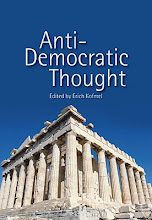
Does at least his academic record match his ego? While I published a book on "Anti-Democratic Thought" in a comparative, cross-cultural, global, and historical context, Duncan spent the last years writing an earth-shattering dissertation on (get this) "The Role of Political Decision Making in the Decline of the Shipbuilding Industries on the [river] Clyde in comparison to its international competitors, 1945-1977". Moreover, he actually got public funding to the tune of some forty or fifty thousand pounds to write such a trite that will be of no concern or interest to anyone but himself.
In his time as General Secretary, Duncan removed me from the NPC mailing list for former officers. (Although he claimed in an e-mail to me that this had not been due to him. Just another lie.) I was pleased indeed to learn that he was removed from that list by his successor in exactly the same fashion.
Ask me again why I am against democracy.
Recently, one Duncan Connors (aka Duncan-Philip Connors) commented on a UK higher education messageboard about the affairs of the soon to be defunct NPC, which is apparently to be absorbed into a newly formed National Union of Students Postgraduate Committee or Conference (NUS-PC). In passing, he made some derogatory remarks about me, a former officer on the Management Sub-Committee (board) of the NPC.
Now, Duncan Connors is well known as a self-aggrandizing pompous git, if there ever was one. In fact, I don't need to insult him myself. I can just cite comments made about him on another blog two years ago: "Duncan Connors was asked to resign [as Deputy Chairman of the Conservative Party in Islington] by a unanimous vote of the executive but refused to accept that his service, or lack thereof, were no longer required. He has tried to create the illusion of a huge scandal in the association by going to the press, sending unsolicited letters and blogging his heart away when in fact, all he wants is a soapbox for his bruised ego and to pursue his own political agenda at everyone else's expense.
"From what I understand he simply wasn't up to the job – [...] All mouth and no trousers.
"the association had no choice but to force him out.
"Duncan is a bit unstable and lives quite close to me I didn't want to become the focus of his obsessive behaviour. Who knows what he is capable of. [...] He is very odd. This is especially the case when he has some moon bat juice driven delusion that he is a 'Major Player' on the political stage. Have a look at the mixture of ego mania and victim syndrome in his ramblings and you will see how likely that is."
Since Duncan's remarks about me were based not on fact, but on what others had said or written about me earlier, I am sure he will agree that a reminder of what others have said publicly about him is in order.
Is there any truth to it, though? A year after I'd left NPC of my own free will (after Duncan and I and a third officer had all run unsuccessfully for Chairman), Duncan was elected General Secretary, the only (ill-)paid position in the organization. Now there are over a hundred universities in the UK and all of them have postgraduates. Usually some forty to fifty of those would affiliate to NPC each year (that is, the local students' union or postgraduate association would pay a few hundred pounds membership fees). In Duncan's year as General Secretary only thirty universities affiliated to NPC. Even worse, the next year only thirteen renewed their affiliation. That's one tenth of UK universities.
With his dismal record in office, Duncan as General Secretary prepared the ground for the imminent take over of the NPC by the NUS. Of course, true to form, he spent the past year trying to blame this on his successor in as many public places as possible.
Duncan becoming General Secretary of NPC was always going to lead to disaster. A man who in more than one e-mail to me (that I still have) boasted that only research council-funded doctoral candidates like himself were worth his attention. How could he ever represent taught postgraduates and self-funding research students (who make up the vast majority of the postgraduate student population in the UK)?
Does at least his academic record match his ego? While I published a book on "Anti-Democratic Thought" in a comparative, cross-cultural, global, and historical context, Duncan spent the last years writing an earth-shattering dissertation on (get this) "The Role of Political Decision Making in the Decline of the Shipbuilding Industries on the [river] Clyde in comparison to its international competitors, 1945-1977". Moreover, he actually got public funding to the tune of some forty or fifty thousand pounds to write such a trite that will be of no concern or interest to anyone but himself.
In his time as General Secretary, Duncan removed me from the NPC mailing list for former officers. (Although he claimed in an e-mail to me that this had not been due to him. Just another lie.) I was pleased indeed to learn that he was removed from that list by his successor in exactly the same fashion.
Ask me again why I am against democracy.
Subscribe to:
Posts (Atom)


 Posts
Posts

