31 August 2011

Book: Shutting out the Sun: How Japan Created Its Own Lost Generation

Google:
Book: Shutting out the Sun: How Japan Created Its Own Lost Generation

A resource for the fledgling research agenda (and Google+ circle) on "the solitary being": Michael Zielenziger (Berkeley), "Shutting out the Sun: How Japan Created Its Own Lost Generation" (Nan A. Talese/Doubleday, 2006).

Quote: "Japan ... confronts an array of disturbing social trends, notably a population of more than one million hikikomori: the young men who shut themselves in their rooms, withdrawing from society. There is also a growing numbers of 'parasite singles': single women who refuse to leave home, marry, or bear children."

16 August 2011

CFP: Anti-Democracy Agenda Symposium 2011

Please circulate widely!

CALL FOR PAPERS

Anti-Democracy Agenda Symposium 2011

Organized by: Sussex Centre for the Individual and Society (SCIS)

Mode: Online by Google+ video conference

Date: 15-16 November 2011

The "Anti-Democracy Agenda" is the premier resource on the net for the study of anti-democratic thought and practice across the boundaries of various traditions and academic disciplines. First introduced by the Sussex Centre for the Individual and Society (SCIS) as a blog in January 2010, it has since been reconstituted as a circle (with associated public posts, much like a blog) on the new social network Google+. An archive of the blog is to be found here: http://anti-democracy-agenda.blogspot.com

For the new circle, see here:
https://plus.google.com/109507108125539761871/posts

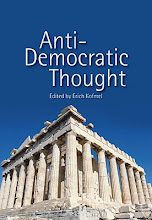
The Anti-Democracy Agenda Symposium 2011 will be the third event we organize to advance the research agenda on anti-democratic thought and practice as well as old and new criticisms of democracy. It will build up on a highly successful workshop on anti-democratic thought SCIS organized at the Annual Conference Workshops in Political Theory in Manchester, England, in September 2007, as well as the Anti-Democracy Agenda Symposium 2010, taking place at the Swiss Federal Institute of Technology (ETH) Zurich in November last year. Both events drew participants from the world over. The Manchester workshop led to the publication of an edited volume on "Anti-Democratic Thought" (Imprint Academic, 2008).

The Anti-Democracy Agenda Symposium 2011 is set to be equally international and interdisciplinary in scope. We invite affiliated academics, independent scholars, and doctoral students and candidates from a wide range of disciplines, such as Philosophy, Political Theory, Political Science, International Relations, Development Studies, Security Studies, Law, Economics, Sociology, Anthropology, Psychology, Literature, History, Classics, Theology, Religious Studies, Education, and so on. Papers may not only cover any and all aspects of criticisms of democracy and anti-democratic thought and practice, from perspectives including anarchism, libertarianism, conservatism, communism, Islamism, the extreme right, and others, but also related concepts such as authoritarianism, dictatorship, military rule, monarchy, chieftaincy, mixed constitution, the backlash against democracy promotion, terrorism, post-democracy, voter apathy, voter ignorance, etc. Have a look at the blog to see what might be of interest and falls within our remit. Papers may be theoretical and/or empirical in nature. Work in progress is welcome too.

This symposium may be the first academic conference to make use of the “Hangouts” video conference facility that is an integral part of Google+. Due to technical restrictions, the number of participants in the Anti-Democracy Agenda Symposium 2011 is limited to 10. All accepted participants will be required to create a profile on Google+ in order to be able to participate in the event. While we encourage the participation of scholars from developing countries, please only apply if you have access to a stable Internet connection. As in our previous physical events, over the course of two days, each presenter will have 60 minutes to present his or her paper and discuss it with all others. Due to the small size of the symposium, all participants are expected to attend both days fully.

As with all SCIS events, no fees will be charged from participants, and no funding is available to cover participants' expenses (if any). We will be glad to issue letters of acceptance on request to assist participants in securing leave from work. Detailed instructions on how to set up a Google+ profile and join the video conference will be provided to confirmed participants.

Please send your proposal to: erichkofmel@gmail.com

Deadline: 15 October 2011

Later submissions may still be accepted, but early submission is strongly advised and proposals may be accepted as they come in.

Cordially,

Erich Kofmel
Managing Director / Research Professor of Political Theory
Sussex Centre for the Individual and Society (SCIS)
https://plus.google.com/109507108125539761871
E-mail: erichkofmel@gmail.com

Postal address:
Sussex Centre for the Individual and Society
1200 Geneva
Switzerland

SCIS is an international association under Swiss law.
Founded 2006 at the University of Sussex.

14 November 2010

CFP: "The Solitary Being" – Symposium in the Botanical Garden

Please circulate widely!

CALL FOR PAPERS

Fifth Anniversary International Symposium "The Solitary Being"

Organized by: Sussex Centre for the Individual and Society (SCIS)

Location: Orangery of the Botanical Garden of the University of Bern, Switzerland

Date: 26-27 May 2011

The "solitary man" is a staple of popular culture as much as philosophy. From medieval religious hermits to people medically diagnosed with autism or antisocial personality disorder, from the lone wolf of American frontier romanticism to the loner running amok in a university, from Ibn Bajjah/Avempace's "The Governance of the Solitary" to Nietzsche's "Übermensch", from the reclusive artist to Japan's tens of thousands of "hikikomori" voluntarily choosing to withdraw from society, examples are not limited to the arguably individualistic modern West, but rather seem to range across all societies, cultures, and times. There always have been those who do not fit the stereotype of man as a social being. Nevertheless, people who keep to themselves and do not engage in collaborative social action tend to be overlooked by social and political researchers and are therefore understudied.

The solitary human being (male or female) has been one of the interests of the Sussex Centre for the Individual and Society (SCIS) since its foundation in 2006. To celebrate our fifth anniversary in 2011, we will be organizing a rare symposium on "The Solitary Being" in the unique settings of a Botanical Garden. Previous SCIS symposia drew participants from the world over. Our anniversary symposium is set to be equally international and interdisciplinary in scope. We invite affiliated academics, independent scholars, and doctoral students and candidates from a wide range of disciplines, such as Anthropology, Sociology, Philosophy, Political Theory, Political Science, Cultural Studies, Literature, Theology, Religious Studies, Psychology, Cognitive Science, Law, History, Education, and so on. Papers may cover any and all aspects of "the solitary being" and/or his or her interaction with the (social) world. Papers may be theoretical and/or empirical in nature. Work in progress is welcome too.

We expect that 15-20 participants will be attending this workshop-style symposium. Over the course of two full days, each presenter will have 45-60 minutes (depending on the number of participants) to present his or her paper and discuss it with all others. The symposium starts early on Thursday and ends Friday late in the afternoon. Due to the small size of the symposium, all participants are expected to attend both days (unless an exception has been agreed in advance, i.e. for religious observance on Friday).

As with all SCIS events, no fees will be charged from participants, and no funding is available to cover participants' travel and accommodation expenses. We will be glad to issue letters of acceptance on request to assist participants in securing funding from their usual sources. The city of Bern – Switzerland's capital –, is connected to both the Zurich and Geneva international airports by direct train (approx. one hour from Zurich, two hours from Geneva) and offers a choice of accommodation. The historic town centre is a UNESCO World Heritage Site. The Botanical Garden of the University of Bern is arranged in descending terraces on the slopes of the river Aar, a tributary of the Rhine. On more than two hectares, it showcases vegetation from various ecological zones, in greenhouses and outdoors, such as alpine plants from Europe, Asia, and North America, tropical and subtropical plants (including orchids, palms, ferns, and cacti), Mediterranean, cold steppe, and semi-desert plants, woodland, water, medical, and fibre plants. Around six thousand plant species will make our anniversary symposium a feast of the senses, forms, fragrances, and colours. Further information will be provided to confirmed participants.

Please send your proposal to: e.kofmel@sussexcentre.org

Extended deadline: 30 April 2011

Later submissions may still be accepted, but early submission is strongly advised and proposals may be accepted as they come in.

Cordially,

Erich Kofmel
Managing Director / Research Professor of Political Theory
Sussex Centre for the Individual and Society (SCIS)
www.sussexcentre.org
E-mail: e.kofmel@sussexcentre.org

Postal address:
Sussex Centre for the Individual and Society
1200 Geneva
Switzerland

SCIS is an international association under Swiss law.
Founded 2006 at the University of Sussex.

13 November 2010

Report on the Anti-Democracy Agenda Symposium 2010: Setting the example for the debate of the future

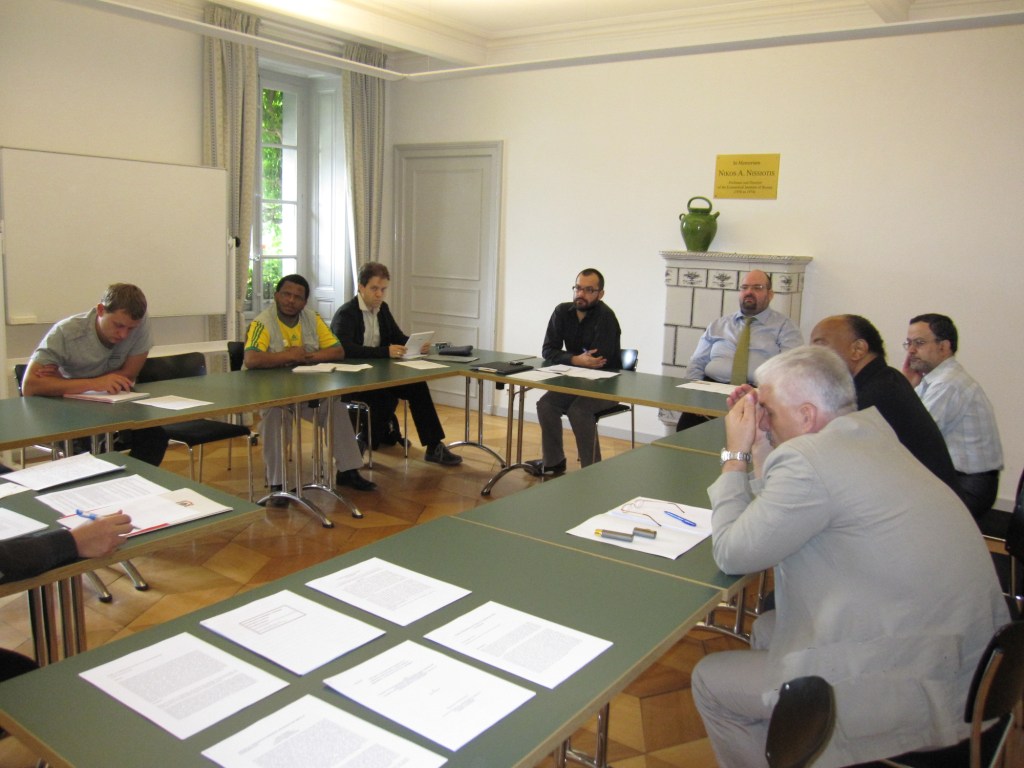
The first event held by the Geneva-based Sussex Centre for the Individual and Society (SCIS) in conjunction with its "Anti-Democracy Agenda" blog, the Anti-Democracy Agenda Symposium 2010, took place to great acclaim on 8 and 9 November 2010 at the Swiss Federal Institute of Technology (ETH) Zurich.

Keynotes to the symposium were contributed by Professor Doh Chull Shin, a native of Korea, director of the Korea Democracy Barometer, and core partner in the Asian Barometer Survey (an ongoing research project monitoring democratization in Asian countries), who is based in the Department of Political Science at the University of Missouri, a leading public research university in the United States, and Professor Kuldip Singh, Head of the Department of Political Science at Guru Nanak Dev University in Amritsar, India.

The Anti-Democracy Agenda Symposium 2010 attracted twelve papers submitted by participants from institutions such as the National University of Singapore, the University of the Philippines, the Technical University of Lisbon (Portugal), Ankara University (Turkey), the University of the Punjab, Quaid-i-Azam University (both Pakistan), the University of Central Oklahoma (USA), and the Islamic Azad University (Iran). Other countries and territories of origin or residence represented include Palestine, Hong Kong, New Zealand, the UK, Switzerland, Nigeria, Korea, and India.

Participants – from doctoral candidates to full professors – came from the disciplines of Political Science, Philosophy, Political Theory, Islamic Studies, Defence and Strategic Studies, Law, and Media Studies, giving theoretical as well as empirical presentations under the titles "Is Confucianism Anti-democratic?", "Islamic Philosophy and Criticizing Democracy", "Against Liberal Democracy", "Anti-Democracy Is Created By Means of Media", "Twenty-First Century Anti-Democracy: Theory and Practice in the World", "A Critique of Western Discourses of Sovereignty and Democracy from Chinese Lenses", "Reflecting on Anti-Democracy Forces in Arab Politics", "'Democracy' in Kazakhstan: Political System Managed from Above", "Pakistan’s Road to Democracy: Islam, Military and Silent Majority", "Democracy: A Form of Government or an Instinct?", "The Role of Ethics in Shaping Democracy: An Examination of Unethical Actions among House of Assembly Members in Nigeria", and "Pekan Anti Otoritarian: Some Observations on Anarchist Gathering at Indonesia".

After a workshop on "Anti-Democratic Thought" in Manchester in 2007, this was the second symposium on anti-democracy organized by the Sussex Centre for the Individual and Society and, once more, it opened up new frontiers for the study of anti-democratic thought and practice. Bringing together scholars from both sides of the debate, advocates of democracy as well as critics and opponents, it set the example for the proper academic conduct of a discussion that does not take place anywhere else, yet. Focusing on twenty-first century anti-democracy, rather than historical expressions and criticisms, it shone the way toward the most important debate of the near future. Asia will play as central a role in that debate as participants from Asia did in our symposium.

The Anti-Democracy Agenda blog and the Sussex Centre for the Individual and Society will continue to be at the forefront of these developments.

13 September 2010

CFP: Political Theology Agenda Symposium 2011

Please circulate widely!

CALL FOR PAPERS

Political Theology Agenda Symposium 2011

Organized by: Sussex Centre for the Individual and Society (SCIS)

Location: Ecumenical Institute of the World Council of Churches (WCC) and the University of Geneva, Château de Bossey, near Geneva, Switzerland

Date: 12-13 July 2011

The "Political Theology Agenda" (www.political-theology-agenda.blogspot.com) has been run by the Sussex Centre for the Individual and Society since January 2009. The blog is the premier resource on the net for the comparative study of political theology and political theologies across the boundaries of various traditions and academic disciplines.

The Political Theology Agenda Symposium 2011 will be the second event we organize in conjunction with the blog. It follows on from a highly successful first symposium held in Geneva in August 2010 and two equally well-received events on comparative political theology SCIS organized earlier, namely, in September 2007, a section and symposium at the General Conference of the European Consortium for Political Research in Pisa, Italy, and, in July 2008, a stand-alone symposium at Sciences Po/the Institute for Political Studies (IEP) in Paris, France. All three events drew participants from the world over.

The Political Theology Agenda Symposium 2011 is set to be equally international and interdisciplinary in scope. We invite affiliated academics, independent scholars, and doctoral students and candidates from a wide range of disciplines, such as Theology, Religious Studies, Philosophy, Political Theory, Political Science, International Relations, Law, Literature, History, Jewish Studies, Education, Cultural Studies, Geography, and so on. Papers may not only cover any and all aspects of political theology, but also related concepts, such as liberation theology, public theology, black theology, the Christian Right, Radical Orthodoxy, religious anarchism, Minjung theology, Dalit theology, radical Islam, religious Zionism, political religion, civil religion, etc. Have a look at the blog to see what might be of interest and falls within our remit. Papers may be theoretical and/or empirical in nature. Although not a condition, we particularly encourage a comparative perspective. Work in progress is welcome too.

We expect that 15-20 participants will be attending the workshop-style Political Theology Agenda Symposium 2011. Over the course of two full days, each presenter will have 45-60 minutes (depending on the number of participants) to present his or her paper and discuss it with all others. The symposium starts early on Tuesday and ends Wednesday late in the afternoon. Due to the small size of the symposium, all participants are expected to attend both days.

As with all SCIS events, no fees will be charged from participants, and no funding is available to cover participants' travel and accommodation expenses. We will be glad to issue letters of acceptance on request to assist participants in securing funding from their usual sources. The 18th-century Château de Bossey, set in an outstanding natural environment overlooking Lake Geneva and the French Alps, offers comfortable accommodation at reasonable prices. Further information will be provided to confirmed participants.

Please send your proposal to: e.kofmel@sussexcentre.org

Deadline: 31 January 2011

Later submissions may still be accepted, but early submission is strongly advised and proposals may be accepted as they come in.

Cordially,

Erich Kofmel
Managing Director / Research Professor of Political Theory
Sussex Centre for the Individual and Society (SCIS)
www.sussexcentre.org
E-mail: e.kofmel@sussexcentre.org

Postal address:
Sussex Centre for the Individual and Society
1200 Geneva
Switzerland

SCIS is an international association under Swiss law.
Founded 2006 at the University of Sussex.
20 August 2010

Report on the Political Theology Agenda Symposium 2010: Political theology goes East and South

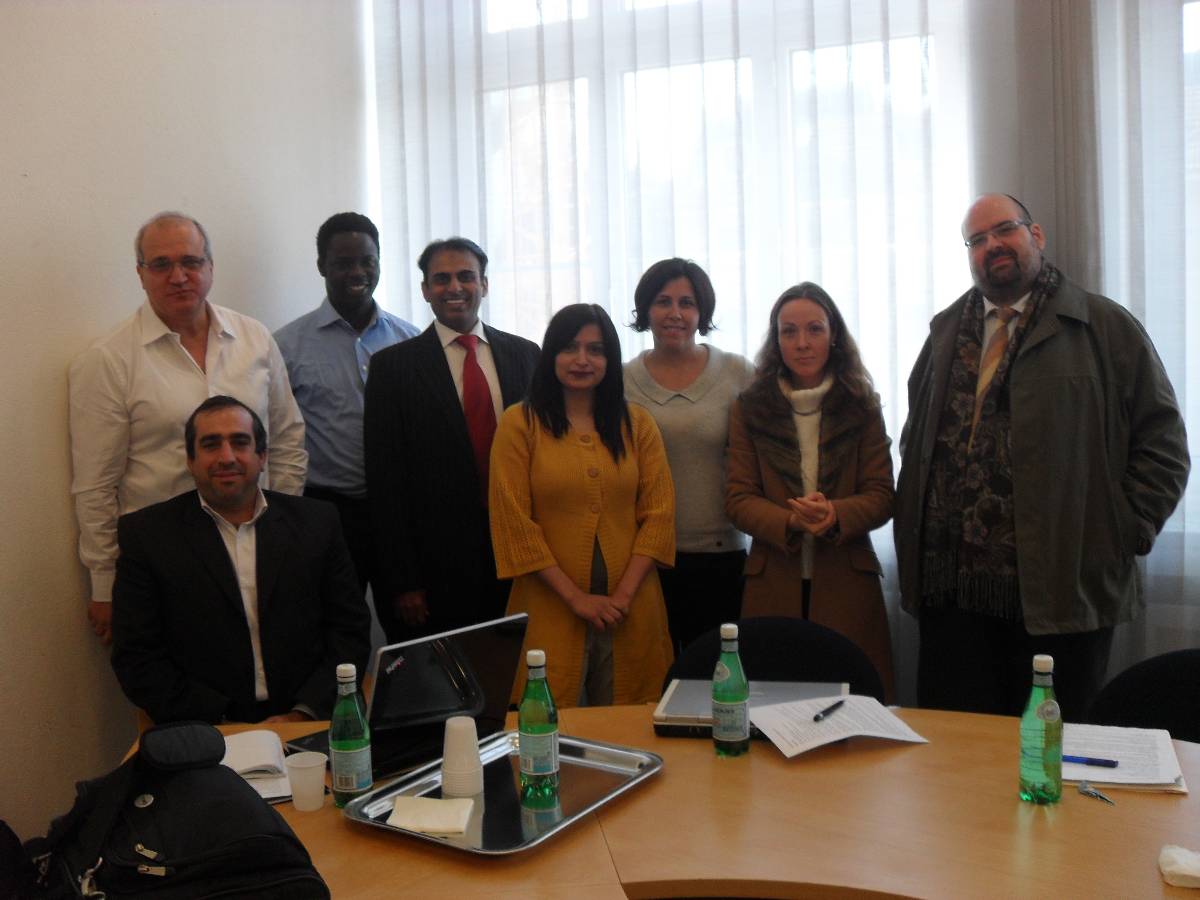
The first event held by the Geneva-based Sussex Centre for the Individual and Society (SCIS) in conjunction with its "Political Theology Agenda" blog, the Political Theology Agenda Symposium 2010, was a full success.

It took place on 18 and 19 August 2010 at the Ecumenical Institute of the World Council of Churches (WCC), Château de Bossey, near Geneva, Switzerland. Bossey doubles as an institute of the University of Geneva since all degrees awarded there (Masters and PhD degrees in Ecumenical Studies) are granted by the University of Geneva.

Keynote speakers were Professor Aliakbar Alikhani, Head of the Institute for Social and Cultural Studies at the Ministry of Science, Research and Technology in Tehran, Iran, and Professor Galip Veliu from the Department of Philosophy at the State University of Tetovo in the Former Yugoslav Republic of Macedonia.

The Political Theology Agenda Symposium 2010 attracted seventeen papers submitted by participants from institutions such as University College London, the University of Birmingham (both UK), the University of Helsinki (Finland), the University of Quebec at Montreal (Canada), the University of Tehran (Iran), the University of the Punjab (Pakistan), the University of South Africa, the University of Zimbabwe, the National University of Malaysia, Universitas Nasional at Jakarta (Indonesia), and San Beda College in Manila (the Philippines). Other countries represented include Macedonia, Romania, Lithuania, Switzerland, and Nigeria.

Speakers – from doctoral candidates to full professors – came from the disciplines of Political Science, Philosophy, Political Theory, Theology, Church History, and Islamic Studies, giving theoretical as well as empirical presentations on subjects including secularization and religious pluralism, political theology, black theology, liberation theology, and radical Islam.

After Pisa, Italy, in 2007 and Paris, France, in 2008, this was the third symposium on political theology organized by the Sussex Centre for the Individual and Society and, once more, it opened up new frontiers for political theology. It was by far the most international event we ever organized (and quite possibly the most international event on political theology to take place anywhere as yet) with five participants from Iran alone and scores of submissions (not all accepted) from the Middle East and East Asia as well as Africa. Taken together with a high number of submissions from (South-)Eastern Europe, there is a significant trend to be observed: after gaining momentum in the Anglophone countries over the past few years, the study of political theology now goes East and South, spreading to Asia and Africa.

The Political Theology Agenda blog and the Sussex Centre for the Individual and Society will continue to be at the forefront of these developments.

(On the downside, all prospective American and Israeli participants withdrew, one by one, from the symposium once they knew that there would be Iranians present. Way to encourage dialogue.)