Just published: Cathryn H. Clayton, "Sovereignty at the Edge: Macau and the Question of Chineseness" (Harvard University Press, March 2010):
www.hup.harvard.edu/catalog/CLASOV.html
Publisher's description: "How have conceptions and practices of sovereignty shaped how Chineseness is imagined? This ethnography addresses this question through the example of Macau, a southern Chinese city that was a Portuguese colony from the 1550s until 1999. As the Portuguese administration prepared to transfer Macau to Chinese control, it mounted a campaign to convince the city's residents, 95 percent of whom identified as Chinese, that they possessed a 'unique cultural identity' that made them different from other Chinese, and that resulted from the existence of a Portuguese state on Chinese soil. This attempt sparked reflections on the meaning of Portuguese governance that challenged not only conventional definitions of sovereignty but also conventional notions of Chineseness as a subjectivity common to all Chinese people around the world. Various stories about sovereignty and Chineseness and their interrelationship were told in Macau in the 1990s. This book is about those stories and how they informed the lives of Macau residents in ways that allowed different relationships among sovereignty, subjectivity, and culture to become thinkable, while also providing a sense of why, at times, it may not be desirable to think them."
Excerpt: "By most standards, Macau is tiny. As of 1998, it covered a land area of just under 24 square kilometers (about nine square miles), but most of its population lived on the 3.5-square-mile peninsula, whose length and breadth it was possible to cover in the space of an afternoon walk. With a total population of approximately 450,000, Macau had the highest population density in the world. [...] In the eyes of Beijing and the world, it seemed, Macau was little more than an afterthought to its larger, more prosperous, and betterknown neighbor Hong Kong, which had preceded Macau in 'returning' to Chinese rule on July 1, 1997."
Review: "Cathryn H. Clayton [...] presents Macau as an alternative to the modern state, which she blames for the 20th century's instability and violence. [...] She suggests Macau's overlapping sovereignty limited power, creating a system where 'no state, indeed no single institution, could assert authority over all aspects of public (or, for that matter, private) life.' She believes this allowed freedoms to flourish. Finally, Ms. Clayton asserts that Macau's confusion and contradiction really represent peaceful coexistence. In that, she sees 'sparks of utopian potential.'" (Jillian Melchior, "Wall Street Journal")
Cathryn H. Clayton is Assistant Professor of Asian Studies at the University of Hawaii.

26 March 2010
Fat liberation theology
 Liberation theology is branching out. The newest addition to this burgeoning field, after black liberation theology, feminist liberation theology, and gay liberation theology, appears to be fat liberation theology.
This is in line with a broader cultural movement, particularly in the United States, campaigning for the liberation and societal recognition of fat people. Similar to the homosexuals who adopted the pejorative "queer" others had labelled them with, the movement of overweight and obese men and women wears with pride the stigma "fat".
That this "fat acceptance" or "fat liberation" movement is increasingly becoming mainstream could be seen at the recent Academy Awards. Not only was the, as they say, "morbidly obese" Gabourey Sidibe nominated as Best Actress for her role in the small independent film "Precious: Based on the Novel 'Push' by Sapphire", but her only slightly less heavy co-star Mo'Nique actually won the Oscar for Best Supporting Actress in the same film.
In theology, this ties in with a book called "The Fat Jesus: Christianity and Body Image" by Lisa Isherwood (Seabury, 2008):
www.churchpublishing.org/products/index.cfm?fuseaction=productDetail&productID=3339
Publisher's description: "We are living in a food and body image obsessed culture. We are encouraged to over-consume by the marketing and media that surround us and then berated by those same forces for doing so. At the same time, we are bombarded with images of unnaturally thin celebrities who go to enormous lengths to retain an unrealistic body image, either by extremes of dieting or through plastic surgery or both. The spiritual realm is not immune from these pressures, as can be seen in the flourishing of biblically and faith based weight loss programs that encourage women to lose weight physically and gain spiritually.
"Isherwood examines this environment in light of Christian tradition, which has often had a difficult relationship with sexuality and embodiment and which has promoted ideals of restraint and asceticism. She argues that part of the reason for our current obsession and bizarre treatment of issues around weight, size and looks is that secular society has unknowingly absorbed many of its negative attitudes towards the body from its Christian heritage. Isherwood argues powerfully that there are resources within Christianity that can free us from this thinking, and lead us towards a more holistic, incarnational view of what it is to be human. The Fat Jesus provides a fascinating study of the complex ways that food, women and religion interconnect, and proposes a theology of embrace and expansion emphasizing the fullness of our incarnation."
Lisa Isherwood is Professor of Feminist Liberation Theologies at the University of Winchester and Vice President of the European Society of Women in Theological Research.
A blog by a Washington State pastoral psychotherapist explicitly promotes fat liberation theology:
http://kataphatic.wordpress.com/
Also interesting: "The Fat Studies Reader", edited by Esther Rothblum and Sondra Solovay, with a foreword by Marilyn Wann (New York University Press, 2009):
www.nyupress.org/books/The_Fat_Studies_Reader-products_id-11104.html
Reviews: "In the US, where two-thirds of the population are overweight or obese, [...] The Fat Studies Reader argues the problem is not obesity per se but the way it is presented in culture. Sociologists point to a 'societal fat phobia' which engenders prejudice against the obese – and argue that this prejudice is tolerated by those who would never dream of making racist or sexist remarks." ("The Independent")
"With a winning audacity, The Fat Studies Reader announces its intention to serve as the foundation of a new academic field. Its editors present convincing voices from law, medicine, social sciences and the humanities, making it difficult to dismiss their case that the time has come for fat studies." ("Ms. Magazine"; here and above italics originally bold)
"Fat studies is an arena where the personal, political and scientific converge, and with this book, readers can mount an informed challenge to the medical construction of obesity and size, the diet industry, insurance companies, public policy and popular culture .... It may be too soon for the movement to offer utopian alternatives, but these essays offer a rich supply of tools for the activist and scholar willing to start the revolution." ("Publishers Weekly")
Esther Rothblum is Professor of Women's Studies at San Diego State University.
Sondra Solovay is Adjunct Professor of Law at John F. Kennedy University and at San Francisco Law School.
19 March 2010
Film: L'Chayim, Comrade Stalin!
The other Jewish homeland: "L'Chayim, Comrade Stalin!" is a 2002 US documentary film by Yale Strom portraying the Jewish Autonomous Region (Oblast) that formed part of the former Soviet Union and is still in existence in today's Russia.
Synopsis: "In April 1928, twenty years before the founding of Israel, Joseph Stalin created the world's first Jewish homeland in the Soviet Union, in a barren stretch of land on Siberia's Far Eastern border. Although conceived as a solution to the 'Jewish problem,' The Jewish Autonomous Region (or J.A.R.), became a center for Yiddish culture and tradition, and was the first place in the world where Yiddish culture thrived. The J.A.R. attracted Jewish settlers from across the Soviet Union and even as far away as the United States, Argentina, and Palestine. By 1948 the Jewish population had peaked at 45,000 (roughly one-quarter of the region's total demographics). The J.A.R. was home to Yiddish schools, theaters, publications and synagogues. Filmed on location in Birobidzhan, capital of the Jewish Autonomous Region, L'CHAYIM, COMRADE STALIN! features interviews with pioneer settlers and current residents, plus footage never before seen outside Russia (as well as the rare propaganda film Seekers of Happiness). This beautifully directed and startling work offers a fascinating glimpse into the most intriguing chapter in 20th century Jewish and Russian histories." (They may be overdoing the hype there ...)
Reviews: "It's rare that historical documentaries aspire to, much less attain, any kind of narrative vigor – the stories are generally too familiar. But 'L'Chayim, Comrade Stalin!' is a bold exception, replete with surprises, twists and thought-provoking anecdotes." ("Boxoffice Magazine")
"Energetic and informative, albeit more than a little haphazard, Yale Strom's new documentary explores [...] a Russian social experiment that sounds as fantastical as any science-fiction script. [...] Stalin got the notion of disposing of Russia's problematic Jews by encouraging them to move to Birobidzhan and become a Yiddish-speaking agrarian proletariat. The Belgium-sized area he selected [...] was closer to Korea than to Moscow. It soon became known to other Russians as 'a very small Jewish town at the end of the world.'" ("Los Angeles Times")
"Like Strom's earlier docs, L'Chayim Comrade Stalin is best appreciated as an exercise in creative ethnography." ("Village Voice")
May not be the best film imaginable on the subject, but it appears to be the only one that actually exists.
Synopsis: "In April 1928, twenty years before the founding of Israel, Joseph Stalin created the world's first Jewish homeland in the Soviet Union, in a barren stretch of land on Siberia's Far Eastern border. Although conceived as a solution to the 'Jewish problem,' The Jewish Autonomous Region (or J.A.R.), became a center for Yiddish culture and tradition, and was the first place in the world where Yiddish culture thrived. The J.A.R. attracted Jewish settlers from across the Soviet Union and even as far away as the United States, Argentina, and Palestine. By 1948 the Jewish population had peaked at 45,000 (roughly one-quarter of the region's total demographics). The J.A.R. was home to Yiddish schools, theaters, publications and synagogues. Filmed on location in Birobidzhan, capital of the Jewish Autonomous Region, L'CHAYIM, COMRADE STALIN! features interviews with pioneer settlers and current residents, plus footage never before seen outside Russia (as well as the rare propaganda film Seekers of Happiness). This beautifully directed and startling work offers a fascinating glimpse into the most intriguing chapter in 20th century Jewish and Russian histories." (They may be overdoing the hype there ...)
Reviews: "It's rare that historical documentaries aspire to, much less attain, any kind of narrative vigor – the stories are generally too familiar. But 'L'Chayim, Comrade Stalin!' is a bold exception, replete with surprises, twists and thought-provoking anecdotes." ("Boxoffice Magazine")
"Energetic and informative, albeit more than a little haphazard, Yale Strom's new documentary explores [...] a Russian social experiment that sounds as fantastical as any science-fiction script. [...] Stalin got the notion of disposing of Russia's problematic Jews by encouraging them to move to Birobidzhan and become a Yiddish-speaking agrarian proletariat. The Belgium-sized area he selected [...] was closer to Korea than to Moscow. It soon became known to other Russians as 'a very small Jewish town at the end of the world.'" ("Los Angeles Times")
"Like Strom's earlier docs, L'Chayim Comrade Stalin is best appreciated as an exercise in creative ethnography." ("Village Voice")
May not be the best film imaginable on the subject, but it appears to be the only one that actually exists.
26 February 2010
Press release: Erich Kofmel promoted to research professorship
Press release: Erich Kofmel promoted to research professorship
26 February 2010
In accordance with Swiss legislation and the laws of the Republic and Canton of Geneva, Erich Kofmel has been promoted to the position of Research Professor of Political Theory at the Sussex Centre for the Individual and Society (SCIS), with effect from 1 March 2010. Professor Kofmel will remain Managing Director of SCIS, the research centre's Board of Directors announced today.
Founded in 2006 at the University of Sussex, England, SCIS has been an international association under Swiss law, based in Geneva, since 2009.
SCIS is not an accredited higher education institution in Switzerland and does not regularly undertake teaching and the professorship awarded to Erich Kofmel, while a signifier of academic excellence, is a research professorship not a university professorship. As an inter- and transdisciplinary research centre, SCIS is formally independent of university structures.
Professor Kofmel (35) is the world's leading expert on anti-democratic thought and practice. He studied for a doctoral degree in social and political thought at the University of Sussex and Sciences Po Paris and holds Master's degrees in Public and Development Management and Roman Catholic Theology as well as a Postgraduate Certificate in Comparative and Cross-Cultural Research Methods. Prior to taking up an academic career, he worked in project and general management in the private, public, and non-governmental sectors in Europe and Africa. A native of Switzerland, he lived for prolonged periods in Senegal, South Africa, England, and France.
Professor Kofmel is the editor of two contributed volumes, Anti-Liberalism and Political Theology and Anti-Democratic Thought (Imprint Academic, 2008), and the author of two academic blogs, the Anti-Democracy Agenda (www.anti-democracy-agenda.blogspot.com) and the Political Theology Agenda (www.political-theology-agenda.blogspot.com). An edited volume on alternatives to democracy in development policy and a monograph, Me Against Mediocrity, are in preparation.
He is available for consultancy mandates particularly in the fields of anti-democratic thought and practice, political theologies, and the interaction of the individual and society.
SCIS continues to invite applications from suitably qualified candidates worldwide to join the centre as Research Associates or Senior Research Associates or to do internships. We are eager to work with people (in person or through electronic communication channels) who will produce original research at the cutting edge of the study of "the individual and society" in any discipline or area of study.
Website: www.sussexcentre.org
Contact: e.kofmel@sussexcentre.org
Sussex Centre for the Individual and Society
1200 Geneva
Switzerland
26 February 2010
In accordance with Swiss legislation and the laws of the Republic and Canton of Geneva, Erich Kofmel has been promoted to the position of Research Professor of Political Theory at the Sussex Centre for the Individual and Society (SCIS), with effect from 1 March 2010. Professor Kofmel will remain Managing Director of SCIS, the research centre's Board of Directors announced today.
Founded in 2006 at the University of Sussex, England, SCIS has been an international association under Swiss law, based in Geneva, since 2009.
SCIS is not an accredited higher education institution in Switzerland and does not regularly undertake teaching and the professorship awarded to Erich Kofmel, while a signifier of academic excellence, is a research professorship not a university professorship. As an inter- and transdisciplinary research centre, SCIS is formally independent of university structures.
Professor Kofmel (35) is the world's leading expert on anti-democratic thought and practice. He studied for a doctoral degree in social and political thought at the University of Sussex and Sciences Po Paris and holds Master's degrees in Public and Development Management and Roman Catholic Theology as well as a Postgraduate Certificate in Comparative and Cross-Cultural Research Methods. Prior to taking up an academic career, he worked in project and general management in the private, public, and non-governmental sectors in Europe and Africa. A native of Switzerland, he lived for prolonged periods in Senegal, South Africa, England, and France.
Professor Kofmel is the editor of two contributed volumes, Anti-Liberalism and Political Theology and Anti-Democratic Thought (Imprint Academic, 2008), and the author of two academic blogs, the Anti-Democracy Agenda (www.anti-democracy-agenda.blogspot.com) and the Political Theology Agenda (www.political-theology-agenda.blogspot.com). An edited volume on alternatives to democracy in development policy and a monograph, Me Against Mediocrity, are in preparation.
He is available for consultancy mandates particularly in the fields of anti-democratic thought and practice, political theologies, and the interaction of the individual and society.
SCIS continues to invite applications from suitably qualified candidates worldwide to join the centre as Research Associates or Senior Research Associates or to do internships. We are eager to work with people (in person or through electronic communication channels) who will produce original research at the cutting edge of the study of "the individual and society" in any discipline or area of study.
Website: www.sussexcentre.org
Contact: e.kofmel@sussexcentre.org
Sussex Centre for the Individual and Society
1200 Geneva
Switzerland
15 February 2010
Book: The Art of Not Being Governed: An Anarchist History of Upland Southeast Asia
In August 2009, Yale University Press published James C. Scott's monograph "The Art of Not Being Governed: An Anarchist History of Upland Southeast Asia":
http://yalepress.yale.edu/yupbooks/book.asp?isbn=9780300152289
Publisher's description: "For two thousand years the disparate groups that now reside in Zomia (a mountainous region the size of Europe that consists of portions of seven Asian countries) have fled the projects of the organized state societies that surround them – slavery, conscription, taxes, corvée labor, epidemics, and warfare. This book, essentially an 'anarchist history,' is the first-ever examination of the huge literature on state-making whose author evaluates why people would deliberately and reactively remain stateless. Among the strategies employed by the people of Zomia to remain stateless are physical dispersion in rugged terrain; agricultural practices that enhance mobility; pliable ethnic identities; devotion to prophetic, millenarian leaders; and maintenance of a largely oral culture that allows them to reinvent their histories and genealogies as they move between and around states.
"In accessible language, James Scott, recognized worldwide as an eminent authority in Southeast Asian, peasant, and agrarian studies, tells the story of the peoples of Zomia and their unlikely odyssey in search of self-determination. He redefines our views on Asian politics, history, demographics, and even our fundamental ideas about what constitutes civilization, and challenges us with a radically different approach to history that presents events from the perspective of stateless peoples and redefines state-making as a form of 'internal colonialism.' This new perspective requires a radical reevaluation of the civilizational narratives of the lowland states. Scott's work on Zomia represents a new way to think of area studies that will be applicable to other runaway, fugitive, and marooned communities, be they Gypsies, Cossacks, tribes fleeing slave raiders, Marsh Arabs, or San-Bushmen."
Reviews: "Few scholars possess a keener capacity to recognize the agency of peoples without history and in entirely unexpected places, practices and forms. Indeed, it leads him ever closer to the anarchist ideal that it is possible for humans not only to escape the state, but the very state form itself." (Prasenjit Duara, National University of Singapore)
"A brilliant study rich with humanity and cultural insights, this book will change the way readers think about human history – and about themselves. It is one of the most fascinating and provocative works in social history and political theory I, for one, have ever read." (Robert W. Hefner, Boston University)
"Underscores key, but often overlooked, variables that tell us a great deal about why states rise and expand as well as decline and collapse. There are no books that currently cover these themes in this depth and breadth, with such conceptual clarity, originality, and imagination. Clearly argued and engaging, this is a path-breaking and paradigm-shifting book." (Michael Adas, Rutgers University)
"Finally, a true history of what pressures indigenous peoples face from these bizarre new inventions called nation states. Jim Scott has written a compassionate and complete framework that explains the ways in which states try to crowd out, envelop and regiment non-state peoples. He could take out every reference to Southeast Asia and replace it with the Arctic and it would fit the Inuit experience too. We need real applicable history that works, that fits. Truth like this, it's too darn rare." (Derek Rasmussen, former community activist in the Inuit territory of Nunavut, advisor to Nunavut Tunngavik Inc.)
"Zomia, he says, offers a sort of counter-history of the evolution of human civilization. . . . What Zomia presents, Scott argues ... is nothing less than a refutation of the traditional narrative of steady civilizational progress, in which human life has improved as societies have grown larger and more comples [sic]. Instead, for many people through history, Scott argues, civilized life has been a burden and a menace." (Drake Bennett, "Boston Globe")
"For those who live in states, savages are those who do not. Yet since the Enlightenment, there have always been Western intellectuals who want to find a critical role for the savage to play. The general idea has been to harness the otherness of indigenous or stateless people as a means of interrogating ... the modern state. In the past twenty years or so, this project has dropped off drastically .... Scott has found a creative way to revive the tradition of critical thinking about the savage – and to highlight the social goals of equality and autonomy embodied in the Zomian social order that states routinely fall short of realizing." (Joel Robbins, "Bookforum")
I decided to put up this book announcement here, rather than on the "Anti-Democracy Agenda", because some of the peoples Scott studies employ forms of autonomous/anarchist self-rule that he labels as "democratic". That label is certainly problematic in the context, since it normally is linked to statehood or a (sub)state-like polity. More importantly, though, even those peoples studied that employ more authoritarian forms of self-rule cannot necessarily be assumed to do so in conscious opposition to democracy as a form of political organization – which may never have entered their thinking.
James C. Scott is Sterling Professor of Political Science, Professor of Anthropology, and Co-Director of the Agrarian Studies Program at Yale. He is a Fellow of the American Academy of Arts and Sciences.
http://yalepress.yale.edu/yupbooks/book.asp?isbn=9780300152289
Publisher's description: "For two thousand years the disparate groups that now reside in Zomia (a mountainous region the size of Europe that consists of portions of seven Asian countries) have fled the projects of the organized state societies that surround them – slavery, conscription, taxes, corvée labor, epidemics, and warfare. This book, essentially an 'anarchist history,' is the first-ever examination of the huge literature on state-making whose author evaluates why people would deliberately and reactively remain stateless. Among the strategies employed by the people of Zomia to remain stateless are physical dispersion in rugged terrain; agricultural practices that enhance mobility; pliable ethnic identities; devotion to prophetic, millenarian leaders; and maintenance of a largely oral culture that allows them to reinvent their histories and genealogies as they move between and around states.
"In accessible language, James Scott, recognized worldwide as an eminent authority in Southeast Asian, peasant, and agrarian studies, tells the story of the peoples of Zomia and their unlikely odyssey in search of self-determination. He redefines our views on Asian politics, history, demographics, and even our fundamental ideas about what constitutes civilization, and challenges us with a radically different approach to history that presents events from the perspective of stateless peoples and redefines state-making as a form of 'internal colonialism.' This new perspective requires a radical reevaluation of the civilizational narratives of the lowland states. Scott's work on Zomia represents a new way to think of area studies that will be applicable to other runaway, fugitive, and marooned communities, be they Gypsies, Cossacks, tribes fleeing slave raiders, Marsh Arabs, or San-Bushmen."
Reviews: "Few scholars possess a keener capacity to recognize the agency of peoples without history and in entirely unexpected places, practices and forms. Indeed, it leads him ever closer to the anarchist ideal that it is possible for humans not only to escape the state, but the very state form itself." (Prasenjit Duara, National University of Singapore)
"A brilliant study rich with humanity and cultural insights, this book will change the way readers think about human history – and about themselves. It is one of the most fascinating and provocative works in social history and political theory I, for one, have ever read." (Robert W. Hefner, Boston University)
"Underscores key, but often overlooked, variables that tell us a great deal about why states rise and expand as well as decline and collapse. There are no books that currently cover these themes in this depth and breadth, with such conceptual clarity, originality, and imagination. Clearly argued and engaging, this is a path-breaking and paradigm-shifting book." (Michael Adas, Rutgers University)
"Finally, a true history of what pressures indigenous peoples face from these bizarre new inventions called nation states. Jim Scott has written a compassionate and complete framework that explains the ways in which states try to crowd out, envelop and regiment non-state peoples. He could take out every reference to Southeast Asia and replace it with the Arctic and it would fit the Inuit experience too. We need real applicable history that works, that fits. Truth like this, it's too darn rare." (Derek Rasmussen, former community activist in the Inuit territory of Nunavut, advisor to Nunavut Tunngavik Inc.)
"Zomia, he says, offers a sort of counter-history of the evolution of human civilization. . . . What Zomia presents, Scott argues ... is nothing less than a refutation of the traditional narrative of steady civilizational progress, in which human life has improved as societies have grown larger and more comples [sic]. Instead, for many people through history, Scott argues, civilized life has been a burden and a menace." (Drake Bennett, "Boston Globe")
"For those who live in states, savages are those who do not. Yet since the Enlightenment, there have always been Western intellectuals who want to find a critical role for the savage to play. The general idea has been to harness the otherness of indigenous or stateless people as a means of interrogating ... the modern state. In the past twenty years or so, this project has dropped off drastically .... Scott has found a creative way to revive the tradition of critical thinking about the savage – and to highlight the social goals of equality and autonomy embodied in the Zomian social order that states routinely fall short of realizing." (Joel Robbins, "Bookforum")
I decided to put up this book announcement here, rather than on the "Anti-Democracy Agenda", because some of the peoples Scott studies employ forms of autonomous/anarchist self-rule that he labels as "democratic". That label is certainly problematic in the context, since it normally is linked to statehood or a (sub)state-like polity. More importantly, though, even those peoples studied that employ more authoritarian forms of self-rule cannot necessarily be assumed to do so in conscious opposition to democracy as a form of political organization – which may never have entered their thinking.
James C. Scott is Sterling Professor of Political Science, Professor of Anthropology, and Co-Director of the Agrarian Studies Program at Yale. He is a Fellow of the American Academy of Arts and Sciences.
09 February 2010
Imprint Academic book covers compared
 The new book (co-edited with András Körösényi and Gabriella Slomp) by Joseph V. Femia, Professor of Political Theory at the University of Liverpool and a former Senior Research Associate of SCIS, has just been published by Imprint Academic. The book's title is "Political Leadership in Liberal and Democratic Theory".
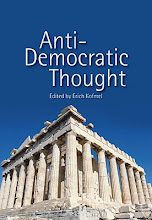
Released on 1 December 2009, precisely a year after my own collection "Anti-Democratic Thought" was published by Imprint Academic, it is interesting to note – and quite likely no one but me would note – that the new book cover shows the exact same picture of an ancient Greek temple that is to be seen on my own book.
One feels compelled to compare.
As good as some of the Imprint Academic cover art may be, the design of the Femia book belongs squarely into the category "awful". While the cover of my own book (to be seen in the left-hand column of this blog) is held in shiny blue, possibly promising a new day and the advent of a non-democratic future, and the temple can symbolize both democratic and anti-democratic political forms that were in existence in ancient Greece, the derivative new cover, held in black and white, plasters Abraham Lincoln and Nelson Mandela across the temple's base and pillars and somehow manages to have Winston Churchill float in the air above the building like a giant balloon.
www.booksonix.com/imprint/bookshop/title.php?9781845401726
Here anyway the publisher's description: "The working hypothesis of this book is that the issue of leadership is neglected by mainstream democratic and liberal theories. This deficiency has especially become evident in the last three or four decades, which have witnessed a revival of deontological liberalism and radical theories of participatory and 'deliberative' democracy. The contributors examine, discuss and evaluate descriptive, analytical and normative arguments regarding the role of leadership in liberal and democratic theory. The volume seeks to provoke debate and to foster new research on the significance and function of leaders in liberal democracies. The book (as a whole and in its constitutive chapters) works on two levels. First, it aims to expose the lack of systematic treatment of leadership in mainstream liberal and democratic theory. Second, it explores the reasons for this neglect. Overall, the book tries to convince the reader that liberal and democratic theories should revive the issue of leadership."
P.S. I'm currently also awaiting Alexandre J.M.E. Christoyannopoulos' monograph "Christian Anarchism: A Political Commentary on the Gospel", which was scheduled for publication by Imprint Academic on 1 January 2010, but does not seem to have been released yet. In 2008, Alex contributed a chapter, "Tolstoy's Anarchist Denunciation of State Violence and Deception", to my "Anti-Democratic Thought":
http://books.google.com/books?printsec=frontcover&id=KkMdJtaaeOYC
Subscribe to:
Posts (Atom)

 Posts
Posts

